THE ICE SILK ROAD: CHINA’S PRIORITY NOW GREENLAND HAS FALLEN
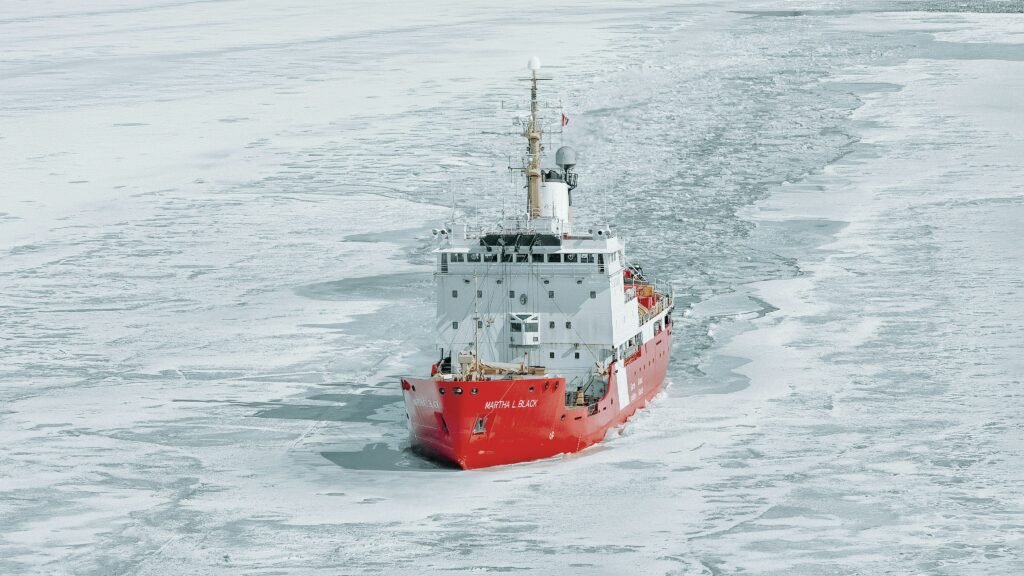
On 9 September 2026, the Dubai Tower arrived at Teesport carrying 1,370 TEU of Chinese goods, an event that might have seemed entirely unremarkable given the vast quantities of batteries, photovoltaic equipment, machinery and other manufactured products that move between China and Europe every day, were it not for the direction from which the ship had arrived. Rather than travelling west through the Indian Ocean and Suez, Dubai Tower had sailed north, passed through the Bering Strait and crossed the Russian Arctic before emerging into the Atlantic after a journey across the top of the world. More importantly, this was not another experimental voyage intended merely to demonstrate that the journey could be made. Istanbul Bridge had already done that in 2025. Dubai Tower was the first sailing in Sea Legend’s 2026 China-Europe Arctic Express programme of eight approximately weekly departures between August and October, using seven vessels. The ships are small by the extraordinary standards of contemporary container shipping, while the service remains seasonal, yet a conceptual threshold has nevertheless been crossed because the Polar Silk Road described for years in Chinese policy papers has ceased to be merely a possibility. Scheduled seasonal China-Europe container shipping through the Arctic now exists.
There is an enormous difference between an explorer proving that a road can be travelled and a merchant publishing a timetable for it, a distinction China itself anticipated when its 2018 Arctic Policy encouraged Chinese companies to conduct commercial trial voyages through Arctic routes in preparation for their eventual “commercial and regularized operation”. Eight years later, the language of a government white paper has begun to acquire physical form, not through an armada capable of challenging Suez, but through something in one sense considerably more significant: ordinary ships carrying ordinary commercial cargo according to a published schedule.
The distinction becomes clearer if the development of the route is understood as a sequence rather than as a binary choice between experiment and maturity. The first stage was the establishment of the Russian Arctic as a resource corridor, particularly for energy and minerals moving between Russian projects and Asian markets. The second consisted of demonstration transits proving that containerised China-Europe commerce could physically cross the Arctic. The third begins when demonstration becomes scheduled seasonal commerce, with multiple ships, predetermined departures, ordinary customers and a European port rotation. That is the threshold being crossed in 2026. A fourth stage would require something considerably more ambitious: several operators, larger vessels, dependable feeder networks and enough seasonal volume for the route to become a recognised component of mainstream shipping rather than a specialised service. Only a fifth stage—near-year-round operation by sufficiently capable merchant and icebreaker fleets—would justify speaking of the Arctic as a genuine systemic alternative to the southern route. The importance of Dubai Tower is therefore not that it proves Stage Five is inevitable, but that the argument that we remain at Stage Two has become obsolete.
At almost exactly the moment Dubai Tower was completing its journey, another development was taking place thousands of kilometres away that appeared at first sight to concern a quite separate argument. Denmark, Greenland and the United States announced that they expect to sign an agreement strengthening security in Greenland and the wider Arctic and North Atlantic, subject to the necessary national parliamentary procedures. The Danish government’s published statement stresses Greenlandic interests, sovereignty, territorial integrity and self-determination, while reporting about the negotiations indicates that the arrangement is expected to provide a substantially strengthened and enduring American security role while restricting military bases and certain sensitive investments by non-allied powers. Until the agreement itself is signed and its provisions are public, the distinction between what the governments have formally announced and what has been reported about its contents matters.
Greenland has emphatically not become American territory, which is why the word “fallen” in the title should not be mistaken for a claim about sovereignty. Yet from the narrower perspective of Chinese grand strategy something consequential appears to be happening, because a territory Beijing once regarded as potentially accessible for investment, minerals, infrastructure and wider Arctic participation is becoming more tightly embedded within a Western security architecture. Greenland has not fallen to China; strategically, it is falling away from it.
This does not make the Ice Silk Road a consolation prize. It makes the road more important because the geography available to China is narrowing at precisely the moment its ability to exploit another geography is expanding.
The conventional map of China-Europe trade is so familiar that its strategic peculiarities have become almost invisible. Goods leave the great ports of eastern China, move towards Southeast Asia, pass through the Malacca Strait, cross the Indian Ocean and approach Europe through a sequence of maritime bottlenecks involving the Middle East, the Red Sea and Suez. These routes enabled globalisation, yet they also created vulnerability because China became an industrial superpower whose prosperity depended upon maritime arteries running through waters it did not control. Turn the globe ninety degrees, however, and the world looks remarkably different. Viewed from the North Pole, Europe, Russia and China no longer appear separated by an enormous southern detour. China sits beneath the eastern entrance to a maritime corridor running along the immense northern coast of Russia before emerging beside northern Europe, so that Shanghai to Rotterdam ceases to look primarily like an east-west journey around Eurasia and begins to look like a journey across its roof.
This is the geographical proposition behind the Northern Sea Route. Depending upon origin, destination, weather and ice conditions, it can considerably reduce the distance and transit time between East Asia and northern Europe, although that does not mean that every Arctic voyage is twice as fast as every Suez alternative, still less that reduced distance automatically produces lower costs. Geography is more complicated than marketing, particularly when the geography contains ice. What the Arctic offers China is nevertheless something Beijing has sought for decades: another artery into Europe.
China has understood the strategic implications for some time. Its 2018 white paper described the country as a “Near-Arctic State” and explicitly connected Arctic shipping to the Belt and Road Initiative, encouraging infrastructure construction, commercial trial voyages and the development of what it called a “Polar Silk Road”. China has no Arctic coastline, though it is one of the world’s largest trading states, energy consumers, shipbuilders and industrial economies, meaning that changing ice conditions, new shipping possibilities and access to Arctic resources affect Chinese interests even if Chinese sovereignty ends thousands of kilometres farther south.
The central Chinese problem is one that cannot be solved by engineering. China can manufacture ships, finance ports, build satellites, process minerals, produce batteries, construct railways and generate enough cargo to populate almost any viable trade route, yet it cannot manufacture geography, and Russia possesses precisely the geography China lacks. Between the Bering Strait and the Barents Sea lie thousands of kilometres of Russian coastline, waters, ports and resources, producing an almost unnervingly complementary relationship in which Russia contributes geography, Arctic operating experience, icebreakers, resources and military power while China contributes cargo, capital, industrial capacity, shipbuilding, processing capability and an enormous appetite for energy and raw materials. Russia can provide the road while China provides much of the traffic.
The estrangement of Russia from the West following its invasion of Ukraine accelerated this complementarity because an Arctic once imagined partly as a space in which Western capital and technology might help develop Russian energy and mineral resources became progressively more isolated from those sources. China consequently became more valuable to Moscow precisely as Russia became more valuable to Beijing, turning the Northern Sea Route from a line across blue water into the potential spine of a much larger economic system.
Travel west from the Bering Strait and a series of names unfamiliar to most Europeans begin to acquire significance: Chukotka, Pevek, Tiksi, Khatanga, Dikson, Sabetta, Yamal and finally Murmansk. They are emphatically not equivalent. Murmansk is a substantial Arctic port and military centre, while Sabetta has been transformed by Russian LNG development; Pevek and Tiksi remain tiny when compared with the giant ports through which conventional global trade moves. The NSR therefore combines substantial infrastructure at particular points with enormous gaps, which Russia is attempting gradually to fill through hydrographic work, vessel monitoring, improved ice forecasting, communications, search-and-rescue facilities and aviation capacity.
The detail matters because the creation of a road across the Arctic is less glamorous than launching an icebreaker but ultimately depends upon hundreds of such interventions. As of September 2026, Russia’s Emergencies Ministry says six integrated Arctic emergency-rescue centres are operating at Murmansk, Arkhangelsk, Naryan-Mar, Vorkuta, Pevek and Sabetta, supplemented by Arctic search-and-rescue units elsewhere. Mi-8 helicopters in Arctic configuration are based at several centres, while the ministry says it has received four longer-range Mi-38 helicopters and intends to prepare crews for landing on nuclear icebreakers. Further facilities are planned or under construction at Tiksi, Dikson, Khatanga and Ugolnye Kopi. None of this means that a vessel in difficulty anywhere across the Russian Arctic enjoys anything resembling North Sea rescue density; it does mean that Moscow is deliberately attempting to convert scattered installations into a more continuous safety architecture.
The ambition extends considerably beyond the statutory boundaries of the Northern Sea Route itself. Russian planners increasingly speak of a Trans-Arctic Transport Corridor linking western Russian ports with the NSR, inland waterways, rail connections and Pacific ports. A successful trade corridor is never merely the strip of water along which the ship moves; it is the collection of ports, railheads, warehouses, river systems, communications, customs infrastructure and industrial projects capable of feeding cargo into it. Rosatom’s current economic model envisages 70–109 million tonnes of cargo by 2030, a transition towards year-round NSR navigation using a convoy model during 2031–35, and a sustainable year-round operating model by 2040. The Russian government is simultaneously testing radar and optical-electronic ice reconnaissance mounted on unmanned aircraft as one component of the navigation system it hopes eventually to operate throughout the year.
Those plans should not be confused with accomplished reality. The NSR carried about 37 million tonnes in 2025, the great majority associated with Russian Arctic cargo rather than international container transit, and announcing a target does not create the cargo required to meet it. Russian Arctic development has repeatedly produced ambitions that proved easier to announce than achieve. The plans nevertheless reveal the intended end-state: Moscow no longer appears to imagine the NSR simply as a coastal lane servicing isolated energy projects, but as the central maritime component of a larger transport architecture connecting European Russia, Siberian resources and Pacific trade.
There is an older Eurasian precedent that helps explain why this distinction matters, although it occurred on land rather than sea. The Mongols did not invent the Silk Roads, along which merchants had crossed Eurasia for centuries before their conquests, yet Mongol rule facilitated substantial transcontinental movement and rulers took measures to foster commerce and communications across their domains. The much-romanticised Pax Mongolica was never a perfectly peaceful free-trade zone, though its underlying economic mechanism is more interesting than the mythology surrounding it: political organisation could convert some of the dangers and uncertainties of enormous distance into something more manageable.
Russia is attempting something conceptually similar in an entirely different physical environment, replacing relay networks, protected travellers and overland infrastructure with ports, helicopters, satellites, hydrographic surveys, ice forecasts, rescue centres and nuclear icebreakers. The economic function is recognisable because a route becomes commercially useful not simply when geography permits passage, but when institutions and infrastructure make that passage sufficiently predictable for merchants to risk their capital upon it. The term “Silk Road” consequently contains rather more historical substance than Chinese branding initially suggests: the old Eurasian routes benefited when political power could make continental distance more governable, while the new one may flourish if Russian power can make Arctic distance governable.
Climate change alone cannot accomplish this because a warmer Arctic does not become the Mediterranean. Ice retreats unevenly, weather remains extreme, darkness and poor visibility persist, and immense distances from rescue infrastructure create risks unfamiliar on conventional shipping routes. This is why Russia’s nuclear icebreaker fleet matters so much. Its Project 22220 vessels and wider nuclear fleet are not spectacular relics of Soviet technological ambition but economic infrastructure, particularly during difficult ice conditions when the constraint is not simply whether an icebreaker can penetrate the ice, but whether sufficient icebreaking and ice-capable merchant capacity exists to sustain systematic navigation. The still more powerful Project 10510 Leader-class Rossiya, currently under construction, points towards the same intended destination—larger vessels moving through more difficult ice at greater speed—although an icebreaker under construction is a planned capability rather than an operational one.
Russia consequently occupies an unusual position in relation to the emerging corridor because it is simultaneously regulator, infrastructure provider, icebreaker operator and provider of many of the services upon which difficult Arctic navigation depends. Place the commercial map on top of the military one and this concentration becomes more striking still. At the western end lies the Kola Peninsula and Murmansk, home to the Northern Fleet and one of the principal concentrations of Russian naval and nuclear power; farther east Russia has developed or refurbished military facilities including Rogachevo on Novaya Zemlya, Nagurskoye on Alexandra Land and Temp on Kotelny Island, accompanied by radar and layered air and coastal defence capabilities across parts of the Russian Arctic.
The significance lies less in counting bases than in recognising the overlap of functions. Ports and icebreakers have strategic as well as economic value, while radar, airfields and communications increase Russia’s ability to operate across a region in which civilian and military geography cannot easily be separated. The commercial infrastructure and the military infrastructure are not sitting on two different maps. They are sitting on the same map, meaning that a Chinese container ship crossing the Russian Arctic is travelling not merely beside Russian territory and through Russian infrastructure but through a region that Moscow regards as central to its own defence.
The question of who actually controls this road is legally much more complicated than describing the Northern Sea Route either as Russian or as international water. Russian law defines the NSR water area as including Russian internal waters, territorial sea, contiguous zone and exclusive economic zone, while the legal status of particular straits and the extent of Russian authority over foreign navigation have long been disputed, notably between Moscow and Washington. Russia asserts extensive regulatory powers over navigation and requires permits under its domestic regime, while other maritime powers have challenged aspects of those claims.
Moscow also relies upon Article 234 of the United Nations Convention on the Law of the Sea, which permits coastal states to adopt and enforce non-discriminatory pollution-control laws in ice-covered areas within their exclusive economic zones where severe climatic conditions and ice covering those areas for most of the year create exceptional hazards to navigation. This creates one of the more elegant contradictions within Russia’s Arctic strategy because its Article 234 argument depends upon conditions involving extensive ice while its commercial opportunity grows as navigation becomes easier. The more climate change makes the NSR routinely navigable, the more economically valuable the route becomes, yet changing ice conditions could eventually sharpen arguments about whether and where Article 234’s requirements remain satisfied. Climate change can therefore increase the economic value of Russian geography while complicating one element of the legal architecture Moscow invokes to regulate it.
Events thousands of kilometres farther south have made the distinction between legal entitlement and commercially usable passage considerably more urgent. Iran continues to impede navigation through the Strait of Hormuz and has sought arrangements under which vessels would pay substantial “service fees”, reportedly amounting to 5–7 per cent of cargo value. Oman has maintained that transit passage through the strait must remain consistent with international law, under which tolls cannot simply be imposed for passage, although charges may be made for specific services rendered to a vessel. Meanwhile commercial traffic remains extraordinarily depressed: Reuters reported only four detected crossings on 15 September, compared with a ten-day average of eighteen, while warning that ships travelling with transponders switched off make precise totals difficult to establish.
A right of passage contained in international law is therefore not identical to commercially usable passage because legal principle matters enormously to states while commercial practice is conditioned by physical risk, insurance and the willingness of crews and owners to expose vessels to danger.
The Portuguese Estado da Índia would have understood the distinction. Portugal never possessed the manpower to conquer the societies surrounding the Indian Ocean and instead attempted to dominate strategically important nodes. Malacca controlled access between the Indian Ocean and the seas of East Asia, Hormuz sat astride the entrance to the Persian Gulf and Goa provided an administrative centre, while Portuguese naval power supported the cartaz system under which merchant vessels were required in many circumstances to obtain Portuguese passes and comply with restrictions governing their trade. The system combined strategic, political and fiscal control, including fees and the coercive taxation of commerce. This was an empire constructed less through continuous territorial possession than through selective control of a network.
The analogy should not be pushed into identity, since international law, technology and sovereignty have changed radically, yet the underlying mechanism remains useful. A state does not necessarily need to own the sea through which commerce passes if it possesses sufficient control over strategically important points, or over the infrastructure necessary to use them, to make merchants take its rules seriously. Russia’s potential model is subtler than Portugal’s because Arctic vessels may genuinely require services Russia is unusually well positioned to provide: ice information, icebreaker assistance, pilotage, search-and-rescue support and navigational infrastructure.
For the shipping company, however, the philosophical distinction ultimately enters the same spreadsheet, which is where the contemporary parallel with Hormuz becomes particularly interesting. Iran is seeking to turn coercive influence over passage through a strategic waterway into an economic charge; Russia already possesses a statutory framework under which charges can be levied for actual icebreaker assistance and ice pilotage on the Northern Sea Route, with Russian law taking account of vessel capacity, ice class, distance and navigation period. These are legally very different propositions. Russian law itself specifies payment according to services actually rendered, while a compulsory charge merely for exercising transit passage through Hormuz would raise a fundamentally different legal issue. Commercially, however, both affect the total cost of moving cargo from one side of a route to the other.
This creates the possibility that Russia could capture a substantial portion of the economic value created by the NSR without ever imposing a naked toll for passage. If the shorter Arctic journey saves a shipping company enough in fuel, vessel days, inventory time or exposure to instability farther south, Russia can charge for the services and infrastructure that make Arctic navigation practicable while leaving the route commercially attractive. The maximum economic rent available to Moscow is therefore influenced not merely by the cost of operating the northern road but by the cost and risk attached to the southern one.
Hormuz consequently offers a demonstration effect considerably more important than today’s disruption alone. Rising insurance costs, delays, security expenses or attempted Iranian charges can increase the effective cost of southern passage, thereby increasing the price at which an Arctic alternative can remain competitive. Every deterioration in the security of Hormuz, Bab el-Mandeb or Suez can therefore increase the relative economic value of Russian Arctic geography. The south can become more expensive, allowing the north to become more expensive while still becoming relatively cheaper.
There is another historical echo here, though it requires care because one of history’s most persistent simplifications is that the Ottoman conquest of Constantinople in 1453 somehow “closed the Silk Road” and forced Europeans to discover a route around Africa. It did not. Portuguese expansion down the African coast had begun before 1453, Mediterranean commerce continued afterwards, and the creation of direct maritime routes to Asian markets emerged from a much longer interaction of commercial incentives, navigational knowledge, state power and competition over intermediated trade.
The useful parallel is therefore not that one route suddenly closed and another replaced it, but that changes in the political economy of established commercial geography can increase the value of alternatives at the same time that technological capability makes previously difficult routes usable. Five centuries ago European navigators responded to the political geography of Eurasian commerce by developing a sea road south around Africa; China may now be responding to the political geography of maritime commerce by developing a sea road north. Suez does not need to close, Hormuz does not need to remain permanently dangerous and Malacca does not need to become impassable; their accumulated vulnerabilities merely have to make diversification sufficiently valuable that developing the northern alternative becomes rational.
The West, meanwhile, is not simply observing this process. Seven of the eight Arctic states are now NATO members, with Finland and Sweden’s accession substantially altering the alliance’s northern geography. In February 2026 NATO launched Arctic Sentry, a multi-domain activity intended to integrate allied activity across the Arctic and High North, while multinational Forward Land Forces began operating in Finland in June. Alaska, Canada, Greenland, Iceland, Norway, Sweden and Finland consequently form an extraordinary allied arc around the Arctic approaches, leaving Russia as the sole Arctic state outside NATO.
The significance is not principally that NATO might attempt to close the Northern Sea Route, but that Western states possess multiple ways of constraining the strategic advantage Russia and China hope to extract from a more accessible Arctic: surveillance of the Bering and North Atlantic approaches, submarine and anti-submarine capabilities, seabed protection, Arctic airfields and ports, additional icebreaking capacity, sanctions and alternative mineral supply chains. Maritime law provides another arena because Washington has long disputed aspects of Moscow’s claims over NSR navigation.
Eventually the most consequential confrontation could concern neither a mine nor a container ship, but a warship. A Western naval vessel asserting navigational rights through waters where Moscow insists upon compliance with Russian regulation could transform an apparently technical disagreement about straits, environmental regulation and coastal-state authority into a direct encounter between incompatible legal interpretations backed by military power. Whether such an operation would be lawful would depend upon the precise route, waters and circumstances; it should therefore be understood as a potential flashpoint rather than an inevitable event. The broader principle remains that increasing commercial importance gives previously obscure maritime-law disputes greater strategic significance.
Greenland fits naturally within this larger architecture. The expected US-Denmark-Greenland agreement does not transfer Greenlandic sovereignty to Washington, and the Danish and Greenlandic governments explicitly emphasise sovereignty and self-determination. Its significance for Beijing lies instead in the prospect of another plausible point of strategic entry into the Arctic becoming more difficult. That possibility is not imaginary: Chinese companies have previously pursued mining investments in Greenland and a Chinese state-owned company was shortlisted for major Greenland airport construction in 2018 before security concerns helped produce an alternative Danish-backed financing arrangement. Chinese interest has therefore existed, although it should not be exaggerated into an established Chinese strategic presence.
Canada makes the pattern more interesting still. European Commission President Ursula von der Leyen has now floated the idea of some form of EU “associate membership” for Canada, while Prime Minister Mark Carney has welcomed deeper cooperation without seeking conventional EU membership. The crucial qualification is that no such EU membership category presently exists: the idea is a political proposal rather than an established institutional status, and any formal arrangement would require extensive negotiation among EU member states. Its significance here is therefore directional rather than constitutional, adding to a broader pattern of closer Euro-Canadian cooperation over defence, energy, technology and critical resources.
The non-Russian Arctic is consequently becoming more politically consolidated within Western institutions at the same time that the Russian Arctic is becoming more economically oriented towards Asian demand, increasing the strategic importance to China of the one Arctic coastline capable of supporting its ambitions at scale.
Minerals transform this from an interesting shipping story into something considerably larger. Russia’s Arctic contains major energy and mineral resources, while Greenland and Canada possess significant critical-mineral potential. The United States, European Union, China and others increasingly treat access to such materials as a strategic supply-chain question rather than simply an exercise in comparative advantage, which is why the nineteenth-century scramble for territory provides only an imperfect analogy. Contemporary powers do not necessarily need to plant a flag over a mine when infrastructure finance, long-term offtake agreements, processing capacity, port access and control over logistics can integrate an asset into a wider economic system.
Greenland becoming harder for Chinese strategic investment would therefore redirect rather than terminate Chinese competition for resources. Kazakhstan has become an important arena in which Chinese, American and other investors compete for copper, tungsten, rare earths and related processing opportunities; the Democratic Republic of Congo remains overwhelmingly important to cobalt; Indonesia dominates nickel mining; and lithium production is concentrated heavily in Australia, Chile and China. Resource states themselves possess agency in this competition, using access to deposits to bargain for processing, infrastructure, employment and technology rather than simply choosing between geopolitical patrons.
The deeper Chinese advantage lies downstream. UNCTAD estimates that in 2025 the Democratic Republic of Congo accounted for 74 per cent of global cobalt mine production and Indonesia for 67 per cent of global nickel mine production, while China dominated refining for rare earths, lithium and cobalt. The mine is therefore not necessarily the moat. A state may possess ore beneath its territory while another controls much of the industrial process that transforms it into battery material, magnets, electronics or other strategically important products. Beijing’s rational response to reduced access in one mineral province is consequently not necessarily to replace one Greenlandic deposit with another elsewhere, but to preserve and deepen a network in which geographically dispersed resources feed processing and manufacturing systems where China already possesses substantial advantages.
The Ice Silk Road could become one component of this system if viewed vertically rather than horizontally. Russian Arctic resources can travel east towards Asian processing and consumption while Chinese manufactured products travel west towards European markets; Chinese capital, cargo and technology can support parts of the system while Russian icebreakers, ports and other infrastructure make the physical corridor possible. A mine in the Russian Arctic, industrial processing in China and a European customer can then form parts of the same logistical architecture.
It is at precisely this point that the argument begins to turn against itself, because Russia and China have overlapping interests rather than identical ones. Moscow wants Chinese investment, customers and shipping without necessarily wanting Chinese strategic autonomy inside a region it regards as fundamental to Russian sovereignty, while Beijing benefits from Russian geography today without necessarily wishing to exchange dependence upon Malacca, Hormuz and Suez for dependence upon Moscow. A strategy designed to diversify China’s vulnerabilities could otherwise merely relocate one of them.
This is where a second Arctic possibility becomes important. The Northern Sea Route follows the Russian Arctic coast because present ice conditions and existing infrastructure make that geography commercially useful, whereas a future Transpolar Sea Route would cross farther north through the central Arctic Ocean. Academic work on the route stresses that its emergence would be gradual and remains uncertain, but continued reductions in sea-ice thickness and extent could eventually make more direct transpolar navigation commercially relevant. Because substantial portions would lie farther from the Russian coastline and within the central Arctic Ocean, its development could alter the degree to which future Arctic commerce depends upon Russian coastal infrastructure and regulation.
China’s long-term Arctic interest may therefore diverge from Russia’s. Beijing benefits today from Russian icebreakers, ports and the coastal corridor, yet a substantially less ice-covered Arctic could eventually increase the attractiveness of routes requiring fewer Russian services. The infrastructure Moscow builds to develop Arctic commerce could paradoxically contribute to a wider commercial and technological ecosystem from which China later seeks greater autonomy.
This leaves an uncomfortable question at the centre of the relationship: is Moscow building a Russian road for China, or is it inadvertently building a Chinese trade artery across Russian geography?
For the moment geography and infrastructure give Russia considerable leverage. Over decades, however, the balance could shift because China can decide how much cargo, capital and industrial demand it commits to Russia, whereas Russia cannot relocate its coastline or easily manufacture another customer of comparable scale. This asymmetry is one reason the emerging Arctic should not be reduced to a simplistic new Cold War in which a coherent Western bloc confronts an equally coherent Sino-Russian one. The Western Arctic is politically consolidating and Russia and China are strategically converging, yet neither development eliminates the interests separating the states inside those alignments.
The Bering Strait adds a final geographical irony because China’s northern route for reducing dependence upon vulnerable southern chokepoints begins with a chokepoint of its own. Only about 82 kilometres separate mainland Russia and mainland Alaska at the strait’s narrowest point, meaning that a Chinese vessel entering the Arctic from the Pacific passes through a gateway bounded by Russia on one side and the United States on the other. The Ice Silk Road does not abolish chokepoint geography so much as rearrange it.
All of this should caution against assuming that the Arctic is destined to become a northern Suez. The shipping season remains limited, ice and weather conditions variable, search-and-rescue infrastructure sparse across immense distances, insurance potentially expensive and the environmental consequences of a major accident severe. Sanctions complicate Russian shipping and finance, intermediate ports remain underdeveloped, and the economies of scale remain formidable: Dubai Tower has a nominal capacity of 1,740 TEU, while the largest vessels used on conventional Asia-Europe trades can carry well over 20,000. Suez is embedded within an enormous ecosystem of ports, feeder services, bunkering, insurance, finance and decades of operational familiarity, meaning that a shorter Arctic voyage on a much smaller vessel does not automatically produce a cheaper container.
Reliability may ultimately matter even more than speed because manufacturers build supply chains around predictable arrival times rather than heroic average voyages. Dubai Tower itself provides a useful warning against confusing scheduled service with mature reliability: its originally advertised UK call was Felixstowe, yet its first 2026 voyage instead arrived at Teesport, while Sea Legend reported route adjustments, speed reductions and schedule deviations associated with changing ice conditions. The company regards the voyage partly as a source of operational data, which is exactly what one would expect from a route that has entered scheduled commerce without yet becoming a mature liner corridor.
Nor can the environmental contradiction be ignored. Commercial opening of the Arctic is being enabled partly by planetary warming, while increased shipping introduces additional emissions, accident risk, underwater noise and ecological disturbance into an unusually vulnerable environment. The Ice Silk Road can simultaneously be an adaptation to changing climate conditions and a source of additional environmental pressure.
These objections matter, although they answer the wrong question if they are used to ask whether the Northern Sea Route will replace Suez. It does not need to. Even a minority route concentrated in higher-value or time-sensitive goods, alongside substantial Russian energy and mineral exports towards Asia, could give China additional redundancy while allowing Russia to derive revenue and strategic leverage from geography once regarded partly as an economic handicap. A second artery can alter the resilience and politics of a trading system without becoming its largest artery.
The apparent “land grab” taking place around the Arctic and the world’s mineral deposits is therefore not principally about land but about systems in which control of ports, mines, offtake, refining, cables, icebreakers, insurance, straits, military facilities and navigation rules can matter almost as much as formal sovereignty. Here the Mongol, Portuguese and early-modern European experiences converge without becoming identical. The Mongols illustrate how political organisation and infrastructure can make difficult distance more commercially manageable; the Portuguese demonstrate how selective control of maritime nodes and licensing systems can produce influence disproportionate to territorial possession; European oceanic expansion demonstrates how changing commercial incentives can make investment in alternative geography rational.
There is something almost beautifully old-fashioned about the conclusion because contemporary power is usually described through artificial intelligence, semiconductors, financial sanctions, cyberwarfare and satellites, all of which matter enormously, while beneath them remains something considerably older. China can dominate manufacturing and still be vulnerable because its ships must pass through narrow stretches of water; Russia can possess a much smaller economy and still own a coastline capable of changing the geometry of Eurasian trade; Iran can demonstrate that a few dozen kilometres of sea can influence the price and movement of energy; Greenland can become strategically important because of where it sits and what lies beneath it. Geography did not disappear during the era of globalisation. We merely became accustomed to a trading system in which its political costs were unusually easy to ignore.
Which brings the argument back to Dubai Tower, a ship tiny in comparison with the armadas passing daily through the established arteries of global trade and carrying cargo statistically insignificant against the enormous volume exchanged between China and Europe. Its route remains seasonal, politically contentious and commercially immature, yet those qualifications are precisely why its journey matters. Great infrastructure rarely becomes historically important at the moment somebody imagines it; the more consequential transition occurs when exceptional journeys become ordinary ones, when the expedition becomes a service, the experiment becomes a timetable and the map begins to shape behaviour.
In 2018 China wrote that it wanted Arctic trial voyages to prepare the way for “commercial and regularized operation”; in 2025 Istanbul Bridge demonstrated a China-Europe container transit; in 2026 Sea Legend began marketing an eight-sailing seasonal programme and Dubai Tower completed its first voyage. During the same period the Western Arctic became more strategically consolidated, Russia continued developing the infrastructure of its northern corridor, disruption farther south demonstrated the economic importance of maritime geography, and China continued searching for ways to make its enormous trading system more resilient.
Perhaps Dubai Tower is merely the beginning of a useful seasonal niche and the economics will never overcome the extraordinary economies of scale enjoyed by conventional routes. Ice, sanctions, politics and environmental constraints may ensure that the Northern Sea Route becomes important without ever becoming dominant. Dominance, though, is the wrong test. Its strategic significance lies in the possibility of giving China an additional maritime artery into Europe running not through the vulnerable southern chokepoints of the existing world economy, but through a corridor in which Russia possesses exceptional geographical and infrastructural leverage.
That reduces one Chinese vulnerability while creating another, because for the moment Russia owns the geography while China supplies much of the potential economic gravity. If the ice continues retreating, if a Transpolar Sea Route eventually becomes commercially viable and if shipping technology reduces dependence upon Russian coastal infrastructure, that relationship may become considerably less comfortable for Moscow. The deepest question raised by Dubai Tower is therefore not simply whether China has discovered another road to Europe, but whose road the Ice Silk Road ultimately becomes.
Greenland has not fallen to China; strategically, it may be falling away from it, making the road across the top of Russia more valuable than it was before.
Dubai Tower has already begun sailing it.