BMI for Robots: It’s the Battery, Stupid.
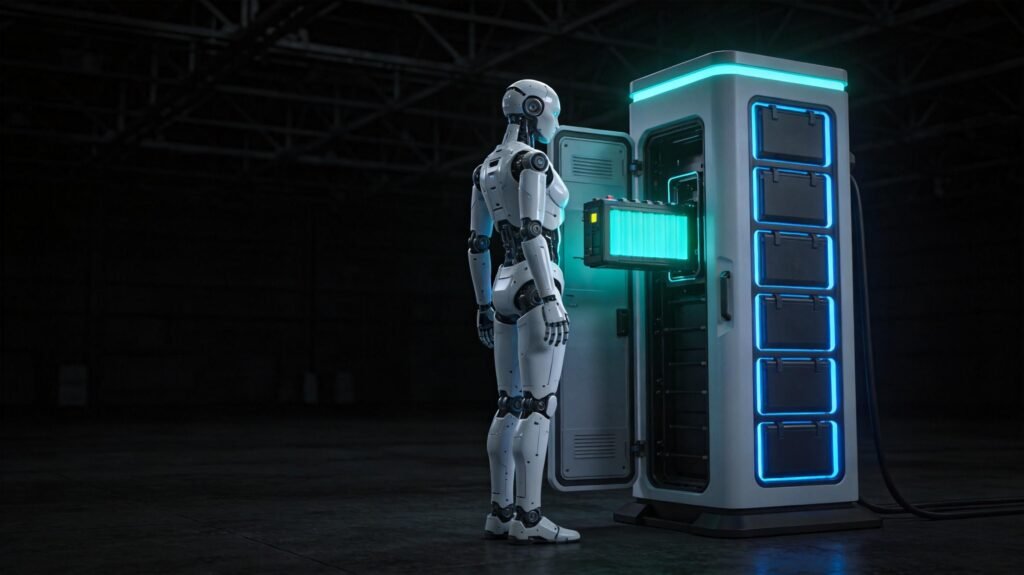
For more than a century, oil sat at the centre of geopolitics because modern industrial power depended upon concentrated, portable energy. Navies converted from coal to oil, armies mechanised, civilian transport exploded and access to petroleum helped determine the strategic importance of entire regions. The Middle East mattered in global politics for many reasons, but oil gave it an extraordinary and enduring centrality. The British Empire worried about fuel for its fleet, Roosevelt met Ibn Saud, Japan’s vulnerability to oil embargoes helped shape its path to war, and later generations of policymakers treated tanker routes, pipelines and producing states as matters of national security. The autonomous and electrified economy may be creating a new version of the same strategic problem, except the crucial technology is no longer the barrel carrying the fuel. It is the device carrying the electricity.
That is why the Pentagon’s recent move on Sila Nanotechnologies is more interesting than it first appears. Washington has offered up to $1.4 billion to support Sila’s expansion of silicon-carbon battery production in the United States, not because the Department of Defense suddenly wants to become an electric-car enthusiast, but because energy density is becoming a strategic variable across an extraordinary range of technologies. Silicon-carbon anodes matter because conventional lithium-ion batteries still rely heavily on graphite, while silicon can theoretically store far more lithium per unit of material. The problem is that silicon expands dramatically during charging, which damages the battery and shortens its life, so the engineering challenge has always been to capture some of silicon’s enormous storage potential without allowing the electrode to destroy itself. Silicon-carbon attempts to do exactly that, and if the technology works reliably at scale, the result is not simply a slightly better consumer battery. It is more range, more endurance, more payload or less weight across any system which depends upon portable electricity.
That sounds technical until it is translated into military or industrial terms. A drone which can fly materially further before its battery runs out has a larger operational radius. A drone carrying the same battery weight but more usable energy can carry more sensors, communications equipment or explosives. A humanoid robot which can operate through an industrial shift instead of stopping repeatedly to recharge becomes much more economically useful. An autonomous ground vehicle, underwater system or remote sensor which remains deployed longer becomes easier to integrate into military operations. Battery improvement therefore has a characteristic which makes it especially geopolitically important: small changes in chemistry can create disproportionate changes in what the system can actually do.
This is where my 20% Rule becomes useful again, not because twenty per cent is some magic engineering threshold, but because modest improvements in a foundational technology can suddenly make an application viable. A robot that lasts six hours may be commercially awkward if a factory operates eight-hour shifts. Increase usable endurance by twenty or thirty per cent and the economic equation changes far more than the chemistry alone would suggest. A drone which falls short of a target by thirty kilometres is militarily useless for that mission, while a slightly better battery can move it across the threshold from impossible to possible. A storage project which does not quite achieve the economics required by a power grid can become viable after a relatively modest fall in cost or rise in cycle life. The relevant question is often not how much better the battery has become, but whether it has crossed the point at which an entirely new use case becomes practical.
Ukraine has already demonstrated why this matters. Modern warfare is rapidly becoming an economy of expendable autonomous and semi-autonomous systems, and the extraordinary scale of drone use on the Ukrainian battlefield has changed assumptions throughout Western defence establishments. Ukraine has built and consumed drones in numbers which would once have sounded absurd for military aircraft, because cheap systems can be manufactured, lost and replaced at enormous scale. Once war begins to look like this, battery production starts resembling munitions production. The twentieth century stockpiled shells, aviation fuel and diesel because the military system could not operate without them. A twenty-first-century military built around drones, robots, distributed sensors and autonomous platforms may have to think just as seriously about cells, anodes, cathodes and the industrial machinery required to manufacture them.
The comparison with oil becomes stronger at precisely this point, although only if we are careful about what the analogy means. A battery is not fuel. It does not contain a primary energy resource in the way a barrel of oil does. It stores electricity generated somewhere else and can usually be recharged many times. Oil is extracted, burned and consumed, while a battery sits between energy generation and energy use. That makes the battery strategically different, but not necessarily less important. Oil transformed the mechanical age because it allowed energy to move through space in concentrated form. Batteries may transform the electrified age because they allow electricity to move through time.
That distinction is fundamental to the energy system. Electricity grids historically had to balance supply and demand almost continuously because electricity itself was difficult and expensive to store. Solar panels produce enormous amounts of power at midday and nothing at night. Wind generation changes with the weather. Cheap grid-scale batteries allow electricity produced at one moment to be used hours later, which means storage gradually separates the timing of electricity generation from the timing of electricity consumption. Oil has always possessed that advantage naturally because a barrel can sit in a tank until somebody needs it. Batteries give electricity a partial version of the same flexibility.
Once electricity can move through time cheaply enough, the geopolitics of renewable energy changes. A country rich in sunlight or wind can store more domestically generated power rather than relying as heavily upon imported hydrocarbons to fill gaps in supply. Oil and gas do not disappear, and claims that batteries somehow end hydrocarbon geopolitics are premature, yet energy storage reduces one of the central weaknesses of intermittent renewables. Whoever manufactures that storage cheaply and at scale therefore gains influence over the pace at which other countries can reorganise their electricity systems.
This is where China enters the story, because China’s battery position is already formidable. China dominates global cell manufacturing and has built deep positions across cathodes, anodes, processing, battery packs and the equipment required to manufacture them. Its advantage is not simply that China happens to possess large deposits of every relevant mineral. In fact, the battery age is much less geographically deterministic than the oil age. Lithium exists in multiple countries, nickel is produced across several regions, graphite can be mined in many places and alternative chemistries such as sodium-ion may eventually reduce dependence upon particular materials. China’s strength comes from having constructed the industrial ecosystem which turns raw material into a functioning battery at scale.
That is one of the great differences between oil power and battery power. Saudi Arabia became strategically important partly because geology placed enormous quantities of oil underneath Saudi territory. China can become strategically important in batteries because industrial policy, manufacturing expertise, infrastructure, capital and scale placed enormous quantities of battery production inside China. Geological power is inherited. Manufacturing power can be built.
This makes the battery supply chain more complicated than the oil supply chain because strategic dependence can appear several layers away from the mine. A country can possess lithium deposits and still depend upon somebody else to refine the material. It can refine lithium while lacking competitive cathode production. It can manufacture cathodes yet still lack the engineering expertise required to produce cells at high yield. It can assemble cells while depending upon foreign equipment or imported graphite. The chokepoint is therefore not necessarily the mineral everybody has heard of.
Graphite illustrates the problem particularly well. China has dominated the production of battery anode materials and has already demonstrated a willingness to use export controls over graphite. A Western country could therefore succeed in obtaining lithium from Australia or South America and still discover that an essential part of its battery ecosystem remains exposed to Chinese policy. This is where the supposedly post-oil energy transition begins recreating an old geopolitical problem in a new industrial form. Countries are trying to escape dependence upon imported fossil fuels while potentially creating dependence upon imported battery materials and manufacturing capacity.
Washington’s response increasingly resembles the broader strategic-capitalism pattern we have already discussed. The Sila financing is not an isolated environmental subsidy. It sits inside a wider effort to create domestic production across critical minerals, battery materials and next-generation technologies because policymakers increasingly regard the market outcome as strategically unacceptable if that outcome leaves the United States dependent upon China. This is an important ideological shift. A classical free-market approach asks where the battery can be produced most efficiently. Strategic industrial policy asks what happens during a major geopolitical confrontation if the efficient producer is the country you are confronting.
The same question explains American support for semiconductors, rare earths and domestic mining. Resilience has acquired a price, and governments are increasingly prepared to pay it. Sila is interesting precisely because Washington is not merely trying to reproduce today’s Chinese battery industry. It is attempting to create a position in the next generation of battery chemistry. If silicon-carbon anodes eventually become commercially significant, American policymakers want domestic capacity to exist before China establishes the kind of manufacturing dominance it already possesses in conventional lithium-ion batteries.
That does not mean silicon-carbon represents an American victory over China. It does not. Chinese battery companies are also investing heavily in next-generation chemistries, while industrialising a promising laboratory technology is extremely difficult. The geopolitical importance lies in the fact that the Pentagon itself has decided the technology matters enough to support at scale. Defence officials are effectively treating battery chemistry as part of the national industrial base, and that makes sense once we stop thinking about batteries as objects sitting underneath electric cars and start thinking about the systems which depend upon them.
Humanoid robots provide a particularly useful example because they connect this battery story to the broader physical-AI revolution. We can build increasingly capable artificial intelligence, sophisticated actuators and extraordinarily dexterous mechanical systems, yet the robot still has to carry its own energy. A humanoid which performs wonderfully for forty minutes and then spends two hours charging will struggle to replace a worker economically. A machine which becomes heavier every time engineers add more battery creates new problems for motors, joints and mechanical efficiency. Physical AI therefore faces a bottleneck which generative AI does not. Intelligence can improve rapidly in software, while energy density tends to improve much more slowly.
This could become one of the most underappreciated constraints on embodied AI. Everyone talks about semiconductor availability and foundation models because those technologies dominate the current AI conversation, yet a robot ultimately has to move. The more intelligent robots become, the more important the energy system underneath them becomes. Unitree, Tesla Optimus and every other serious humanoid programme therefore depend not just upon better AI but upon continuing improvements in batteries, motors and power management.
The same applies to autonomous military systems. A drone’s intelligence can become extraordinary, yet there is little strategic value in exquisite autonomy if the aircraft cannot remain airborne long enough to reach its target. A robot can navigate a battlefield beautifully and still become a liability if soldiers have to carry enormous quantities of replacement batteries behind it. Modern warfare therefore turns energy density into logistics, and logistics remains one of the oldest determinants of military power.
This is why the phrase “energy density is range” is more than a slogan. In a mobile system, usable energy becomes distance, endurance, payload or some combination of the three. A better battery can therefore produce an advantage throughout the system without changing the software at all.
The oil analogy becomes especially useful when we consider scale. Oil’s strategic importance came not simply from technological sophistication but from volume. Modern civilisation consumed staggering quantities of it, meaning access to production, refining and transportation became a national concern. The battery age could develop a similar logic if autonomous systems proliferate by the millions. One exquisite battery inside an experimental aircraft is not geopolitically important. Billions of cells inside cars, robots, drones, grid-storage systems, data centres and military platforms are.
China’s advantage here is familiar. It has repeatedly demonstrated an ability to turn technologies into massive industrial systems. Batteries became cheaper partly because Chinese manufacturers achieved enormous scale and then competed ferociously with one another. The resulting cost reductions transformed electric vehicles and made grid storage progressively more viable. The strategic significance therefore comes not only from better chemistry, but from the ability to manufacture conventional chemistry cheaply enough that it spreads everywhere.
This creates another important distinction between innovation and industrialisation. America may invent an impressive battery chemistry and still lose the strategic contest if China becomes the country which manufactures it at scale. The same argument applies to humanoid robots and many other technologies. Laboratory leadership and industrial dominance are not identical. The country which discovers the next chemistry acquires an advantage, yet the country which builds the factories, supply chains, technicians, processing plants and equipment companies can capture much more of the eventual geopolitical value.
Indonesia demonstrates how this new map of stored energy becomes more multipolar than the oil system. Indonesia has become enormously important in nickel and has encouraged domestic processing rather than simply exporting raw ore, often with Chinese investment. Australia is a major source of lithium and other minerals. Chile and Argentina possess extraordinary lithium resources. China dominates many processing and manufacturing stages. America is trying to reconstruct domestic capacity. Europe has enormous demand but weaker positions in several parts of the supply chain.
The battery age therefore creates a new geography of strategic resources, but it does not simply replace Saudi Arabia with China. Mineral-rich countries can acquire leverage, processing powers can acquire a different kind of leverage and advanced manufacturers can acquire another layer of influence. The winners will often be countries which manage to capture more than one stage of the value chain.
Latin America’s lithium triangle provides an obvious warning. Possessing lithium does not automatically create battery power any more than possessing iron ore automatically creates an advanced automotive industry. If Bolivia, Chile or Argentina simply exports raw material which is refined and converted into cells elsewhere, much of the strategic value leaves with the ore. Resource nationalism in the battery age will therefore increasingly focus not just upon who owns the mine, but upon who refines, manufactures and captures the intellectual property downstream.
This creates opportunities for countries which were peripheral to twentieth-century oil politics. Indonesia can turn nickel into industrial leverage. Australia can combine mineral abundance with alliances and advanced processing. Gulf states may use hydrocarbon wealth to purchase positions inside battery, renewable and critical-mineral supply chains. Saudi Arabia and the UAE understand better than almost anyone that strategic energy dominance is enormously valuable, so it would be surprising if they simply watched the energy system evolve without trying to own part of the next one.
The Middle East may therefore remain important even in a more electrified world, although for different reasons. Oil exporters can use existing wealth to invest in mining, processing, electricity generation, storage and the technologies surrounding the transition. The future does not have to be oil versus batteries. A rational petro-state can sell oil while using the proceeds to acquire stakes in the infrastructure which gradually reduces global oil dependence.
This is where the title “The Battery Is the New Oil Barrel” needs restraint. China cannot form a simple battery equivalent of OPEC and permanently dictate the price of stored electricity. Battery chemistry can change, alternative materials can be substituted and manufacturing plants can be built elsewhere. Recycling can eventually return valuable materials into the system. Sodium-ion batteries may become important in applications where lithium is unnecessary, while silicon-carbon itself could reduce dependence upon conventional graphite-heavy anodes. Technological innovation therefore makes battery power less permanently concentrated than geological oil power.
The battery is not the new oil because China can become Saudi Arabia.
The battery is the new oil because stored energy is becoming as strategically important to the autonomous and electrified economy as liquid hydrocarbons became to the mechanical economy.
That is a much stronger analogy.
Oil powered machines because concentrated fuel gave vehicles, ships and aircraft mobility. Batteries increasingly power machines which contain intelligence. That creates an extraordinary common denominator across technologies which otherwise appear unrelated. A humanoid robot, an FPV drone, an electric vehicle, a warehouse robot and a remote military sensor may have completely different functions, yet all require portable stored electricity. Grid storage operates on a different scale but solves the same fundamental problem of shifting electrical energy to where and when it is useful.
Semiconductors determine what an autonomous system can calculate. Communications networks determine what it can connect to. The battery determines how long it can remain physically useful.
Once that becomes clear, the geopolitical stakes of battery chemistry look very different.
The twentieth century’s strategic thinkers understood that industrial power depended upon energy. Churchill’s decision to move the Royal Navy from coal towards oil helped transform British strategic thinking about access to petroleum. Japan’s vulnerability to fuel restrictions demonstrated that military capability could become irrelevant if the energy required to move it disappeared. Germany’s wartime search for fuel shaped campaigns and industrial strategy. America became extraordinarily powerful partly because it possessed abundant domestic energy alongside its industrial base.
The autonomous age will not recreate those exact circumstances, yet the same underlying principle survives. A state can possess extraordinary software, brilliant engineers and sophisticated weapons, but machines still require energy to operate. The more warfare, transport and industry electrify, the more battery production begins to resemble strategic energy infrastructure.
This is why the Pentagon’s investment in silicon-carbon should not be read merely as another subsidy to a fashionable clean-technology company. Washington is betting that improvements in stored energy can influence several strategically important systems simultaneously. Better cells can improve drones, robots, electric vehicles, portable military electronics and potentially the economics of grid storage, while domestic production reduces dependence upon Chinese supply chains.
That combination of technological leverage and industrial sovereignty is what pushes the topic into genuinely large geopolitical territory.
The next major battery breakthrough might not look dramatic. It may not involve a miraculous solid-state cell which doubles range overnight. A fifteen or twenty per cent improvement in energy density, cycle life or cost can be more geopolitically important if it crosses the threshold which allows a technology to scale. The 20% Rule applies because systems are full of thresholds. Slightly better chemistry can make a drone’s mission possible, a robot’s shift practical or a storage project profitable.
The strategic competition will therefore be fought partly at the level of incremental engineering. Chemistry improves, manufacturing yields rise, cells become cheaper, supply chains deepen and industries which previously existed only in demonstrations begin becoming ordinary infrastructure. China has repeatedly proved unusually good at that stage of technological competition.
That is why the outcome cannot be predicted simply by asking which country invents the best battery. The more interesting question is which country constructs the ecosystem capable of making good batteries abundant.
If China remains dominant, it gains influence over the cost structure of electric transport, autonomous machines and storage throughout much of the world. If the United States succeeds in creating competitive domestic technologies and production, it reduces another strategic vulnerability. If emerging mineral producers capture more processing and manufacturing rather than remaining raw-material suppliers, the geopolitical balance shifts again.
What we are watching is therefore not a simple energy transition from oil to electricity. It is the construction of another strategic commodity system layered on top of the existing one.
Oil will remain important for decades.
Gas will remain important.
Nuclear power may become more important.
Renewables will expand.
Batteries sit between many of those systems because they allow electricity to become more portable, more flexible and more useful.
That is why the humble cell begins to acquire geopolitical weight far beyond its size.
For a century, geopolitical power depended partly upon who could supply the fuel which made machines move.
The machines are beginning to think now, and increasingly they are beginning to move without us.
They still need something to keep them moving.
Oil powered the age of machines.
Batteries power the age in which the machines think, meaning the next great energy struggle will be over the battery…n’est ce pas?