Ann Coulter: The Foundation Trump Built His Presidency On
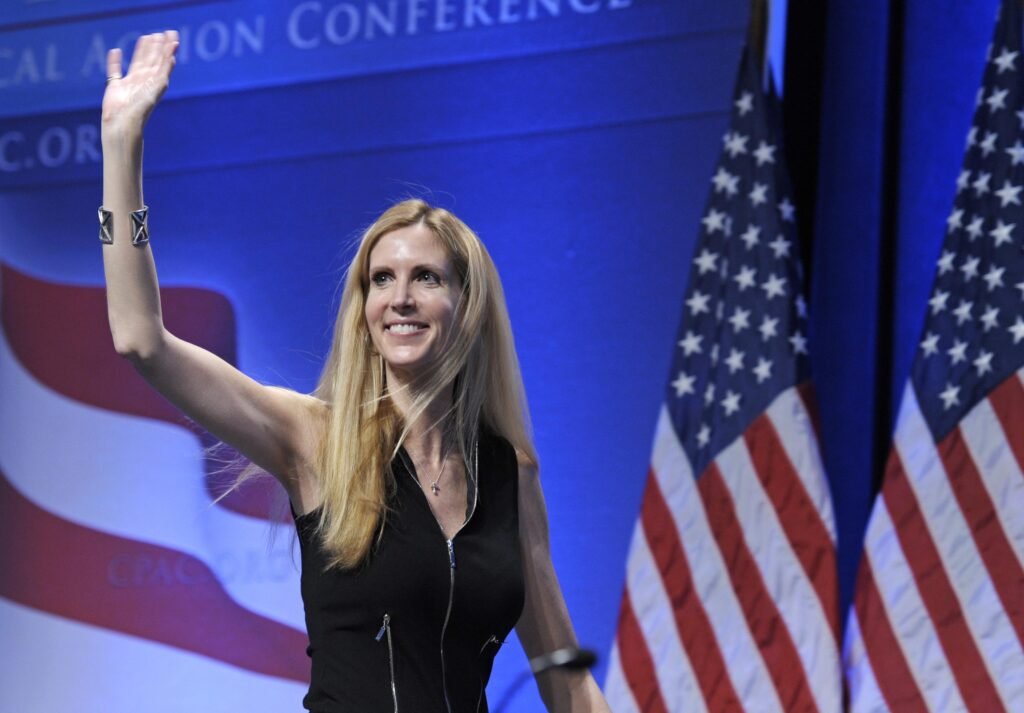
When Donald Trump descended the golden escalator at Trump Tower on 16 June 2015 and announced
his candidacy for the presidency of the United States, much of the political establishment heard a
billionaire celebrity saying outrageous things about Mexico. Ann Coulter heard something rather
different. She heard someone finally running for president on an argument she had spent years trying
to force upon a Republican Party that did not particularly want to hear it. The timing was extraordinary.
Coulter’s ¡Adios, America! had appeared only weeks earlier, and in assessing the likely Republican
presidential contenders she had discussed the familiar inhabitants of establishment Republican politics
without considering Trump a serious political force. Trump was not yet the vehicle for the political
transformation she imagined. Within months, however, Coulter had become one of his most
enthusiastic prominent supporters, not because Trump had converted her to a new politics but because
she believed that he had unexpectedly arrived at hers. This distinction provides a useful starting point
for understanding both Coulter and the intellectual prehistory of Trumpism, because Donald Trump did
not invent the forces that eventually carried him into the White House, and Ann Coulter certainly did not
invent them either. American nationalism, immigration restriction, protectionism, hostility towards
foreign entanglements, suspicion of Washington and resentment of cultural elites all have histories
extending far beyond either figure. Ross Perot and Pat Buchanan had already demonstrated parts of
the potential coalition, the Tea Party had revealed the intensity of anti-establishment feeling on the
American Right, while the financial crisis, the Iraq War, the China shock and the hollowing out of
industrial communities had weakened confidence in assumptions shared by much of the political
establishment. Coulter’s peculiar importance lies elsewhere. Before Trump discovered that these
grievances could be fused into a presidential coalition, she had already assembled several of them into
a remarkably recognisable prototype of what would become MAGA.
This was not where Coulter began. Her intellectual and professional formation was thoroughly
embedded in the conservative establishment she would later spend much of her career attacking.
Cornell was followed by the University of Michigan Law School, work around the Senate Judiciary
Committee, constitutional argument, the Clinton impeachment battles and eventually a highly
successful career as a conservative author and television polemicist. The Coulter of the 1990s therefore
appeared to be an unusually aggressive specimen of movement conservatism rather than the precursor
of a new kind of Republican politics. The Reagan settlement within which that conservatism operated
was itself reasonably coherent. Low taxation, deregulation, free trade and relatively liberal movements
of capital sat alongside social conservatism and a muscular conception of American leadership abroad.
Corporate America and Republican politics were natural partners, while immigration, although
contested, was not normally treated as an existential challenge to the conservative project. George W.
Bush could advocate immigration reform while remaining entirely recognisable as a conservative
Republican, just as John McCain and later Marco Rubio could support pathways towards legal status
without imagining that they were abandoning the philosophical foundations of their party. Business
wanted workers, agriculture wanted workers, technology companies wanted skilled migrants, and
Republican strategists increasingly worried that an uncompromising position on immigration would
alienate a growing Hispanic electorate. The assumption underlying all of this was that immigration
represented one difficult policy question among many.
Coulter’s great heresy was to argue that immigration was not one issue among many because
immigration eventually altered all the other issues. Her argument developed from a relatively
conventional concern about illegal immigration into something much more encompassing. Immigration
affected the supply of labour and therefore potentially the bargaining position of workers; it affected
housing, schools, infrastructure and public expenditure; it altered communities and cultural
expectations; and, ultimately, because immigrants could become citizens and citizens could vote, it
1affected the future composition of the electorate itself. From this perspective, conservative victories on
taxation, regulation, guns, abortion or the size of government could eventually become irrelevant if
conservatives simultaneously acquiesced in demographic changes that transformed the electorate
deciding those questions. Immigration was therefore not simply a subject upon which future voters
would express preferences. It could help determine who those future voters were.
There were substantial weaknesses in this analysis, particularly when Coulter converted probabilities
into certainties. Demography does not translate mechanically into political allegiance, as Trump’s own
later gains among Hispanic voters would demonstrate. Immigrant communities assimilate politically as
well as culturally, party coalitions change, generations behave differently from their parents, and ethnic
identity does not impose a permanent voting preference. Coulter’s rhetoric frequently flattened these
complications because polemic rewards certainty more readily than sociology does. The economic
argument also becomes much weaker when expressed in its most sweeping form. The strongest
research does not support the proposition that immigration simply impoverishes native-born American
workers. The National Academies concluded that immigration’s overall long-run effect on native wages
is very small and that immigration contributes positively to long-run economic growth. The workers
most plausibly exposed to negative wage effects are previous immigrants and native-born workers with
relatively low levels of formal education who compete most directly with new lower-skilled arrivals. Yet
embedded inside Coulter’s exaggeration was a question that would become enormously important to
Trumpism: what if an economic policy can increase aggregate national wealth while imposing
substantial losses upon particular Americans?
That question was potentially devastating to the economic language through which both Republican
and Democratic establishments had described globalisation. Immigration could increase output, free
trade could increase efficiency, cheaper imports could improve consumer welfare and global supply
chains could lower production costs, allowing economists to demonstrate perfectly legitimately that the
American economy as a whole had gained. Coulter’s instinctive response was to ask who, within
America, had gained. The difference between those two questions looks small but ultimately represents
one of the largest intellectual shifts between Reaganism and MAGA, because it moves the unit of
political analysis from the economy to the citizen.
This becomes clearer when immigration is considered alongside trade. The economic consensus
surrounding globalisation was not a conspiracy and much of it was correct. Trade produced enormous
consumer benefits and improved aggregate efficiency, while China’s integration into the global
economy contributed to an extraordinary reduction in global poverty. What the optimistic version of this
argument underestimated was the geographical and social concentration of adjustment costs inside
advanced economies. The work of David Autor, David Dorn and Gordon Hanson on the China shock
demonstrated that American labour markets exposed to Chinese import competition adjusted much
more slowly and painfully than conventional models had suggested. Employment and wages suffered in
highly exposed communities, labour-force participation weakened and the expected movement of
displaced workers towards more productive employment elsewhere often occurred far less smoothly
than theory implied. A cheaper television purchased in California and a lost manufacturing job in Ohio
could both appear inside the same calculation of national welfare, yet they were not politically or
socially equivalent events. Consumer gains were dispersed across hundreds of millions of people while
industrial losses could be concentrated within a town whose economic purpose, property market, social
institutions and collective confidence depended upon a handful of employers.
Coulter was not an economic theorist of deindustrialisation and it would be an exaggeration to credit
her with anticipating the empirical literature on the China shock. Her contribution was more primitive
but politically powerful: she refused to accept that demonstrating an aggregate economic gain ended
the argument. If corporations increased profits by moving production abroad, affluent Americans
2benefited from inexpensive imported goods and employers gained access to cheaper labour while
particular groups of American workers experienced weaker bargaining power or disappearing
employment, she wanted to know why conservatives automatically regarded the resulting arrangement
as a victory. This was an attack not merely upon globalisation but upon the hierarchy of values
underlying Reaganite conservatism. Markets were no longer necessarily the mechanism through which
the national interest revealed itself. They were instruments whose outcomes could legitimately be
judged against a prior conception of national interest.
Once that inversion is made, much of MAGA economics becomes internally coherent even where its
individual policies remain contestable. A factory moving from Ohio to China can be economically
rational for the corporation, profitable for shareholders and beneficial for consumers buying the
resulting cheaper products while simultaneously being judged strategically undesirable for the United
States. A tariff can impose costs upon consumers yet still be defended if it preserves industrial capacity
considered important to national resilience. Domestic energy production can be valued not merely
according to price but according to the geopolitical vulnerability created by dependence.
Semiconductor fabrication, steelmaking, shipbuilding and critical-mineral processing can cease to be
ordinary sectors in which the cheapest global supplier should automatically prevail and instead become
components of national power. The underlying question has changed from whether the market has
allocated resources efficiently to whether the resulting allocation strengthens the country.
This is the philosophical bridge between Coulter and MAGA, and it is considerably more important than
any claim that Trump simply copied policies from one of her books. Coulter increasingly conceived the
nation as something more than a marketplace containing interchangeable economic actors. Citizenship
mattered because governments owed obligations to citizens that they did not owe equally to everyone
else; borders mattered because membership of the political community required definition; cultural
continuity mattered because societies required sufficient common identity to sustain solidarity;
productive capacity mattered because national independence could not always be purchased on the
world market. Trump converted these instincts into the brutally effective slogan America First, but the
slogan contained a question that Coulter had been asking for years: what would American policy look
like if every major decision were judged first according to its effects upon Americans rather than
according to an abstract model of global economic efficiency?
Trump’s tariff policy eventually provided one answer, although the empirical record complicates the
triumphalist account. Research into the tariffs imposed during his first presidency found little evidence
that protection significantly increased employment in the affected industries, while foreign retaliation
damaged American exporters, particularly agriculture. Consumers and importing businesses also bore
substantial costs. Yet the tariffs proved politically popular in many of the communities they purported to
protect. This apparent contradiction reveals something essential about economic nationalism. Its
appeal is not solely the promise that protection will produce more jobs than free trade. It is also
expressive. A government imposing tariffs communicates that the disappearance of an American
industry counts as a national problem rather than merely as the efficient geographical reallocation of
production. For communities that believed both parties had spent decades explaining why their
economic losses represented the unfortunate but necessary price of aggregate prosperity, that change
in language mattered enormously.
Coulter understood this emotional economy before most professional Republican politicians did, just as
she understood another political technology that Trump would eventually industrialise: the power of
transgression. Long before Trump demonstrated that a presidential candidate could dominate the news
cycle by violating almost every convention governing presidential speech, Coulter had constructed a
career around precisely the same mechanism. Her books were arguments packaged as provocations,
their titles frequently designed to make opponents advertise them through denunciation, while
3television appearances became confrontations in which outrage was not an accidental by-product but
part of the method of distribution. The system worked because condemnation itself generated
attention. A statement that respectable politicians considered unsayable would provoke media outrage;
the media, in condemning it, would repeat it; supporters who already distrusted the media would
interpret the condemnation as evidence that a protected truth had been touched; and attempts to
exclude the speaker would reinforce the speaker’s status as an outsider. The opposition therefore
participated involuntarily in distributing the message it wanted to suppress.
Trump’s great discovery was that this mechanism could be applied to presidential politics on an almost
unlimited scale. The innovation was not merely offensiveness, since American politics had hardly lacked
offensive politicians, but the refusal to complete the traditional ritual that followed outrage. A politician
said something unacceptable, respectable institutions condemned it, advisers panicked, the politician
apologised and institutional authority was thereby reaffirmed. Trump simply removed the apology.
Coulter recognised the importance of this almost immediately after his 2015 announcement because
she expected the backlash against his comments about Mexican immigration to force the usual retreat.
Instead he intensified the argument. The political significance of that refusal extended far beyond
immigration because it exposed a weakness in the establishment’s enforcement mechanisms.
Institutions retained immense power to condemn, but among a substantial part of the electorate they
no longer possessed sufficient authority to make condemnation disqualifying. Once a voter believed the
media itself to be dishonest, being condemned by the media could become evidence in the accused
politician’s favour.
This helps explain why Trump’s decisive victory in 2016 occurred before he defeated Hillary Clinton. He
first defeated the Republican Party. Jeb Bush represented almost everything the emerging insurgency
had come to distrust: dynastic politics, immigration reform, donor networks, conventional free trade,
the Bush foreign-policy inheritance and an assumption that Republican politics remained bounded by
institutional norms. Trump did not attempt to win admission to that establishment. He attacked its
legitimacy, turning the Republican primary into something closer to a hostile takeover than a leadership
contest. Coulter had again prepared part of the terrain because her contempt had never been reserved
for Democrats. Republican politicians who promised border enforcement and failed to deliver it could
attract greater fury than Democrats who had never made the promise, while corporations did not
qualify as conservative allies merely because they wanted lower taxes if they simultaneously wanted
inexpensive foreign labour. The important political division therefore increasingly ran vertically as well
as horizontally, separating insiders from outsiders, globalists from nationalists, managerial institutions
from the people who believed those institutions no longer represented them.
The categories were crude and often contradictory. Trump was a Manhattan billionaire presenting
himself as the champion of displaced industrial workers, while Coulter herself was an Ivy League-
trained lawyer and bestselling author rather than an excluded victim of elite America. Populism has
always involved elites competing for the authority to represent anti-elite sentiment. Yet the underlying
dislocation was real, particularly across parts of the industrial Midwest where communities that had
once supported Democrats moved towards Trump. The political opportunity lay in recognising that
voters could be economically interventionist, culturally conservative, sceptical of immigration, hostile to
foreign wars and contemptuous of corporate elites without fitting comfortably inside either party’s
inherited ideological categories. Trump did not create those voters. He assembled them.
At this point Coulterism escaped Coulter and became MAGA, because MAGA was always larger than
anything she had articulated. Steve Bannon supplied a more expansive theory of nationalist-populist
revolt, Stephen Miller converted immigration restriction into administrative strategy, Robert Lighthizer
developed a far more sophisticated challenge to the post-Cold War trading system, and J.D. Vance
eventually helped provide the movement with a younger and more intellectually self-conscious post-
4Reagan vocabulary. Trump contributed the indispensable element none of them possessed: an
extraordinary capacity to fuse separate grievances into personal political loyalty. Coulter had supplied
part of the diagnosis, but Trump discovered the coalition.
The distinction between the first Trump campaign and the mature MAGA movement becomes
particularly important when examining the second presidency, because Trumpism has gradually
evolved from a politics concerned primarily with the boundary of the United States into a theory about
the strategic space surrounding it. The 2016 campaign concentrated upon controlling immigration,
building the wall, renegotiating trade agreements, confronting China, rebuilding American
manufacturing and avoiding wars that did not obviously advance American interests. The organising
concept was national sovereignty. By the second Trump presidency, however, sovereignty had begun
expanding geographically. The question was no longer merely who should be allowed into America but
what America should be prepared to allow within its strategic neighbourhood.
The result is what Trump has embraced as the Donroe Doctrine, a superficially comic label for a
development that may prove considerably more consequential than the joke suggests. The
administration’s National Security Strategy explicitly describes a Trump Corollary to the Monroe
Doctrine under which the United States intends to restore American pre-eminence in the Western
Hemisphere, protect access to strategically important geography and prevent non-hemispheric
competitors from establishing threatening capabilities or controlling strategically significant assets. The
accompanying defence strategy similarly places hemispheric dominance and denial of hostile strategic
positions near the centre of American security. What initially appeared to be disconnected Trumpian
fixations on Greenland, the Panama Canal, Mexico, Venezuela, migration routes, energy resources,
critical minerals and Chinese infrastructure investment can therefore be read as components of a
developing geopolitical architecture.
The historical comparison is illuminating precisely because the new doctrine is not simply the Monroe
Doctrine repeated. Monroe’s 1823 proposition was principally exclusionary: European powers should
not extend their colonial systems further into the Americas. Theodore Roosevelt’s corollary transformed
that defensive principle by asserting a much broader American right of intervention within the
hemisphere. The Donroe Doctrine combines elements of both while adapting them to an era in which
strategic power is exercised through infrastructure and supply chains as well as armies. The principal
outsider is no longer Europe but China, with Russia and Iran occupying secondary roles, while the
strategic assets requiring protection may be ports, telecommunications networks, canals, energy fields,
mineral deposits and logistical infrastructure rather than colonies. The emerging proposition is that
countries throughout the Americas remain formally sovereign, but some of their relationships with rival
great powers may nevertheless be treated by Washington as matters of American national security.
This represents a remarkable evolution of America First because it exposes how misleading the
conventional description of Trump as an isolationist has always been. Trumpism is not inherently
opposed to the exercise of American power abroad. It is opposed to exercises of power whose benefits
cannot be connected sufficiently directly to American interests. A universalist conception of American
foreign policy asks what responsibilities the United States bears for maintaining an international order
from which it and its allies benefit. The Donroe conception asks where American dominance produces
sufficiently tangible strategic advantages to justify its costs. The result can be less American
involvement in one region and considerably more in another without necessarily appearing
contradictory from within the doctrine itself. Europe can be told to assume greater responsibility for its
defence while Washington becomes more assertive in Latin America; nation-building in the Middle East
can be dismissed as folly while coercive intervention in the Caribbean is presented as homeland
security; distant alliances can become increasingly transactional while the American sphere of influence
becomes more rigid.
5America First, viewed this way, does not mean America alone. It means America dominant where
dominance matters.
Venezuela is the clearest test of this transformation. The 2026 American operation against Nicolás
Maduro represented a dramatic assertion of American power, but the administration’s explanation is
particularly revealing. Marco Rubio framed Venezuela not as another Iraq or Libya but as a Western
Hemisphere problem, emphasising its relationships with Iran and other American adversaries and
explicitly grounding American interest in geography. That distinction implies a hierarchy within
American strategy. Baghdad is distant; Caracas is not. A hostile alignment thousands of miles from the
United States may be undesirable, but a hostile strategic presence within the Caribbean basin can be
treated as an immediate security problem. The Donroe Doctrine therefore replaces the universal
geography of liberal internationalism with concentric circles of national interest.
Venezuela also demonstrates how thoroughly economics and geopolitics have merged within mature
MAGA. The country possesses the world’s largest proven petroleum reserves, overwhelmingly
concentrated in heavy and extra-heavy crude, while sophisticated refineries on the American Gulf Coast
possess infrastructure historically suited to processing heavy sour oil. Venezuelan petroleum therefore
intersects simultaneously with American refinery economics, energy security, migration, sanctions
policy and the strategic competition with China and Russia. If Washington succeeds in drawing
Venezuelan production and investment increasingly into an American-centred economic system while
reducing Chinese, Russian and Iranian influence, the result would represent the Donroe Doctrine in
material rather than rhetorical form. Energy would cease to be merely something traded between firms
and become one component of a reconstructed American strategic sphere.
The implications reach beyond Venezuela. The Panama Canal matters because the movement of goods
is geopolitical power. Greenland matters because Arctic geography, rare-earth resources, missile
warning and future shipping routes are strategic assets. Mexico matters because migration, narcotics,
industrial supply chains and Chinese investment converge immediately across the American border.
Latin American ports matter if ownership or operation can create strategic leverage for Beijing. Critical
minerals matter because an energy transition dependent upon supply chains controlled by a rival great
power replaces one form of vulnerability with another. Once economic infrastructure is understood as
strategic infrastructure, the hemisphere begins to look less like a collection of unrelated sovereign
economies and more like a system within which Washington believes it possesses legitimate security
interests.
There is an obvious problem with this reasoning. From much of Latin America, it looks remarkably like
the return of American imperialism. The Monroe Doctrine and particularly the Roosevelt Corollary are
remembered throughout the region not simply as principles of continental security but as intellectual
justifications for interventions, occupations and the subordination of Latin American sovereignty to
Washington’s preferences. A doctrine asserting that the United States may determine which forms of
Chinese investment, Iranian cooperation or Russian involvement neighbouring countries are permitted
to accept risks reproducing precisely the hierarchical politics MAGA condemns when global institutions
or foreign governments attempt to constrain American sovereignty.
The geopolitical contradiction is equally serious. If Washington openly embraces the legitimacy of
spheres of influence, Beijing can ask why geography should not confer comparable privileges upon
China in East Asia, while Moscow can make the same argument concerning its own neighbourhood. It is
difficult to insist simultaneously that proximity gives the United States exceptional strategic rights in
Venezuela while Russian claims of special security interests in Ukraine or Chinese claims around Taiwan
are illegitimate in principle. The cases are not equivalent historically, legally or morally, but a world
6organised explicitly around great-power spheres becomes less hospitable to the universal rules upon
which American objections to rival spheres have traditionally rested.
The realist response is that such spheres have always existed regardless of whether international law
acknowledges them. Great powers invariably care more about events close to their borders than
identical events thousands of miles away, and pretending otherwise does not abolish power politics.
From this perspective the Donroe Doctrine merely replaces euphemism with strategic clarity. America
cannot police every region indefinitely, but neither can it reasonably allow a peer competitor to
accumulate military, technological and infrastructural leverage throughout the Caribbean and Latin
America while Washington concentrates its resources elsewhere. A selective American hegemony within
its own hemisphere could therefore be presented not as a repudiation of restraint but as the
geographical condition that makes restraint elsewhere possible.
The danger lies in determining where security ends and appetite begins. If every economically valuable
resource becomes strategically vital, every Chinese investment becomes a national-security threat and
every neighbouring government’s foreign relationships become legitimate subjects of American
coercion, a doctrine supposedly designed to limit American commitments could become a mechanism
for continuously expanding them. A sphere of influence is only a strategy of restraint if somebody can
define its boundaries.
This is precisely where Ann Coulter re-enters the story, because the foreign-policy implications of
mature MAGA expose a contradiction between the movement she helped anticipate and the movement
Trump has subsequently constructed. Coulter was not always an anti-interventionist, and any attempt
to present her as one retrospectively is historically false. She supported the Iraq War and defended
important elements of that decision long after many other commentators had abandoned it. Yet her
politics subsequently evolved towards an increasingly severe scepticism of foreign wars that she
believed lacked a direct connection to American security. By Trump’s second presidency she had
condensed her preferred programme into two demands that she regarded as repeatedly promised and
repeatedly betrayed by American politicians: enforce the border and stop fighting unnecessary wars.
Iran therefore created something more significant than another Coulter-Trump quarrel. Her furious
reaction to Trump’s 2026 Iran war reflected her belief that America First was being violated by the man
who had transformed it into a governing philosophy. For Coulter, voters had repeatedly demanded less
immigration and fewer foreign interventions, only to discover that governments could always find
money and political energy for another overseas conflict while failing to complete the border
infrastructure they had promised. Her complaint was therefore not that Trump had ceased being
personally agreeable to her. It was that the instrument had departed from the programme.
This exposes the unresolved foreign-policy division within MAGA. One interpretation of America First is
restraint: the United States should secure its borders, rebuild its industrial base, stop attempting to
transform distant societies, compel wealthy allies to assume greater responsibility for themselves and
reserve military force for direct threats to American security. Another interpretation is primacy: the
United States should cease apologising for its power, dominate its strategic neighbourhood, deny rival
powers access to critical infrastructure, control the resources and supply chains necessary for national
strength, demand more from allies and use overwhelming force whenever doing so produces a clear
American advantage. These approaches can coexist rhetorically for long periods because both reject
liberal internationalism and both claim to prioritise the national interest. They cease to coexist
comfortably when military force is actually required.
Coulter increasingly represents the restraint side of that divide, while the Donroe Doctrine embodies
the primacy side. Trump contains both, which is why his foreign policy can appear incoherent when
7forced onto the conventional spectrum between isolationism and internationalism. The more useful
description is transactional nationalism. The relevant question is not whether America should engage
with the world but whether each engagement produces a sufficiently concrete American benefit.
Ukraine can therefore be viewed sceptically because defending it imposes substantial costs far from the
American homeland, while Venezuela can simultaneously attract extraordinary intervention because
geography, migration, energy and rival-power involvement make it part of the American strategic
environment. Iran is more difficult because the geographical argument weakens while the security
argument remains, creating exactly the possibility Coulter fears: that America First can gradually
reproduce the interventionism it originally promised to replace.
Her willingness to make this criticism is central to understanding her relationship with Trump. Coulter
has never been reliably loyal to the man, and this is evidence of her intellectual role rather than a
curious footnote to it. During Trump’s first presidency she turned on him viciously when she concluded
that he was failing to build the border wall he had promised. For Coulter, the test was always delivery.
Trump mattered because he appeared capable of implementing a programme that conventional
Republicans would not implement, and if he failed to do so he forfeited the reason for supporting him.
This is fundamentally different from the relationship that developed between Trump and millions of
MAGA voters for whom the individual gradually became the embodiment of the movement itself.
Coulter’s loyalty remained ideological where theirs became increasingly personal.
The resulting paradox became more pronounced as the Republican Party moved towards her on the
very issues over which she had once been considered extreme. Immigration restriction moved from the
insurgent edge of Republican politics to its centre. Stephen Miller became one of the most powerful
architects of the second Trump administration. Deportation, once discussed cautiously by
establishment Republicans, became explicit government policy. Tariffs ceased to be an eccentric
rejection of conservative economics and became normal instruments of American economic statecraft.
China scepticism became bipartisan. Industrial policy returned to Washington. Supply-chain resilience,
strategic manufacturing, semiconductor capacity and critical minerals entered the national-security
vocabulary. The pandemic, the Ukraine war and deteriorating relations with Beijing had demonstrated
that an economic system optimised for efficiency could contain vulnerabilities invisible to conventional
measures of welfare.
The Republican Party therefore became progressively more Coulterian at precisely the moment Ann
Coulter became progressively less Trumpian. That is her strange victory, and it also demonstrates why
intellectual influence should not be confused with authorship. Trump did not read Coulter and construct
a presidency from her books. MAGA cannot be reduced to Coulterism any more than Reaganism can be
reduced to Milton Friedman. Political movements emerge from collisions among ideas, interests,
personalities, economic shocks and electoral opportunities. Coulter’s contribution was diagnostic rather
than architectural. She recognised several fractures before the Republican establishment accepted that
they existed.
She recognised that immigration possessed an electoral potency conventional Republicans were
underestimating, that the interests of corporations and conservative voters were not necessarily
identical, that working-class Americans could reject economic arrangements economists described as
beneficial in aggregate, that attacking Republican elites could strengthen rather than destroy a
Republican politician, and that elite condemnation was losing its disciplinary power among people who
had ceased trusting elite institutions. Most importantly, she recognised that nationalism could provide a
common language connecting these otherwise disparate grievances. Where she was wrong, she was
often spectacularly wrong. Her demographic arguments became deterministic, her immigration
rhetoric repeatedly collapsed distinctions that serious analysis requires, and her talent for provocation
rewarded exaggeration because outrage generates attention more effectively than qualification. Her
8economic arguments sometimes transformed legitimate distributional concerns into broader claims
unsupported by the evidence, while her foreign-policy evolution becomes artificially tidy only if her
earlier enthusiasm for Iraq is conveniently forgotten.
Yet clinical analysis requires applying the same standards to her opponents. The pre-Trump
establishment was wrong about important things too. It underestimated how persistent trade shocks
could be within particular communities, underestimated the political consequences of
deindustrialisation, underestimated the salience of immigration, overestimated voters’ commitment to
Republican free-market orthodoxy, underestimated exhaustion with the wars that followed September
11 and profoundly underestimated how much legitimacy the media, universities, government agencies
and political parties themselves had lost among large sections of the population. Above all, it confused
the boundaries of respectable political conversation with the boundaries of possible political opinion.
Coulter understood that they were not the same, and Trump proved it.
What followed was not merely another Republican presidency but a redefinition of the hierarchy within
American conservatism. Markets remained important, private enterprise remained indispensable and
taxation remained politically powerful, but none automatically outranked the national interest. The
nation came first, and once that premise was accepted its logic expanded remarkably far. It began with
the border because a border determines membership, extended into trade because trade distributes
gains and losses among members, moved into industrial policy because productive capacity determines
resilience, encompassed energy because resources provide strategic independence, and ultimately
arrived at geopolitics because a sovereign nation powerful enough to defend itself must decide how
much control it requires over its surrounding environment.
That is the intellectual road from Coulter’s wall to Trump’s Donroe Doctrine, and it contains the central
irony of MAGA. A movement born partly from anger at American global overextension has produced a
doctrine of regional supremacy. A movement that condemned institutions for overriding national
sovereignty increasingly asserts American prerogatives over the strategic decisions of neighbouring
sovereign states. A movement promising fewer wars has discovered that defining additional interests as
vital can create additional reasons to use force. A movement whose most memorable proposition was
that America should stop trying to run the world may be evolving towards the proposition that America
must unquestionably run its portion of it.
None of this makes the Donroe Doctrine inherently incoherent. Geography remains real regardless of
ideology. The Panama Canal matters, Caribbean security matters, Mexican state capacity matters,
Venezuelan oil matters, migration matters, critical minerals matter and Chinese control of strategically
significant infrastructure in the Americas would concern any serious American administration. A
superpower that dispersed enormous resources across distant theatres while ignoring the strategic
transformation of its immediate neighbourhood would indeed be behaving strangely. The difficult
questions concern degree rather than existence: how much exclusion of rival powers is necessary for
American security, when economic preference becomes imperial control, when securing infrastructure
becomes dictating another state’s sovereignty, whether recognising an American sphere inevitably
legitimises Russian and Chinese claims to spheres of their own, and at what point America First requires
so much American activity abroad that it destroys the restraint it originally promised.
Ann Coulter cannot answer these questions for MAGA because MAGA has outgrown her. She was never
its philosopher and there is no sufficiently systematic Coulter doctrine to justify describing her as such.
Her more interesting historical role was that of an early-warning system. She detected failures
accumulating beneath the Republican consensus before most professional Republicans understood
their electoral significance. She saw that immigration could break the party, that corporate
9Republicanism could become vulnerable to economic nationalism, that working-class voters could
become available to a Republican willing to abandon parts of Republican orthodoxy, that voters might
prefer someone who fought institutions they distrusted to someone certified as respectable by those
institutions, and that the American Right was becoming less interested in conserving the post-Cold War
settlement than in overthrowing it.
Then Donald Trump descended an escalator and discovered that these propositions were not merely
material for bestselling polemics. They constituted an electoral strategy. Eleven years later, the wall has
become a hemisphere. An argument that began with who should be permitted to enter the United
States has expanded into an argument about who should be permitted strategic influence throughout
the Americas. The economic nationalism once directed against cheap labour now encompasses tariffs,
industrial capacity, supply chains, energy resources and critical minerals, while hostility towards elite
consensus has developed into hostility towards significant elements of the institutional architecture
through which the United States organised its post-war international leadership. America First has
evolved from a campaign slogan into an attempt, still contradictory and still unmistakably Trumpian in
its improvisation, to establish a new hierarchy of American interests.
Coulter helped prepare the ground for that transformation without controlling what was eventually
constructed upon it, which may explain why her relationship with Trump remains so revealing. She can
look at the second Trump presidency and plausibly see both vindication and betrayal. The immigration
restrictionism she demanded has become central Republican policy, the economic nationalism she
anticipated has displaced much of the old free-trade orthodoxy, and the Republican establishment she
despised has been routed within its own party. Yet the president she celebrated as the vehicle for
America First can still embark upon the kinds of foreign military commitments she increasingly regards
as violations of the very mandate that brought him to power.
The Republican Party became more Coulterian as Ann Coulter became less Trumpian. That is not merely
an amusing footnote to the history of MAGA but a clue to what MAGA actually is. Donald Trump did not
inherit a finished ideology from Ann Coulter. He inherited a political landscape in which she had spent
years identifying fault lines that more conventional Republicans preferred not to see, then connected
those fault lines, widened them, personalised them and constructed an electoral coalition across them.
Miller, Bannon, Lighthizer, Vance and others subsequently added structures Coulter had never designed,
while China, Covid, Ukraine, the border, energy insecurity and renewed great-power competition
supplied pressures that transformed the original building still further.
Ann Coulter did not build the Trump presidency. She helped excavate the ground upon which it could be
built. Trump built MAGA on that ground, and by his second presidency MAGA had become something
larger and stranger than either could have envisaged in June 2015: a political philosophy that began by
demanding a wall around America and arrived, through the relentless logic of sovereignty, at a doctrine
asserting American strategic primacy across an entire hemisphere.
Coulter helped teach the American Right to put America first. Donald Trump discovered that the
unanswered question was how much of the world America First required America to control.