AI + ASKESIS + THE MONASTIC LIFE (but sex included)
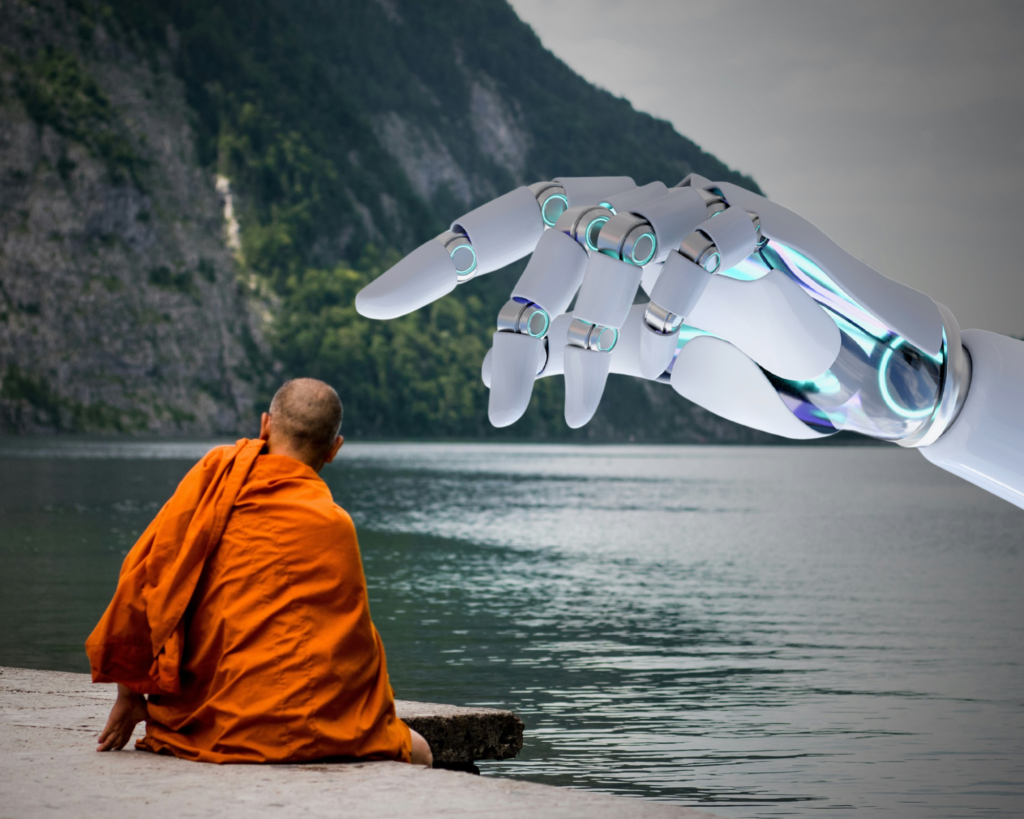
The great misunderstanding about the AI abundance economy is that freedom from work will make life less structured. For humans to flourish, it may require the opposite: stronger routines, simpler consumption, deeper communities and deliberately chosen constraints. The technological future could therefore look strangely ancient — part monastery, part gymnasium, part village. But with better healthcare, universal intelligence and, mercifully, sex.
To see why, we need to take seriously, at least for the duration of the thought experiment, the strongest version of the abundance argument. Suppose artificial intelligence becomes capable of performing most cognitive work at negligible marginal cost and increasingly capable robotics does something similar for physical labour. Add abundant energy and automated manufacturing and much of what is expensive today because it contains large quantities of human labour becomes progressively cheaper. Intelligence itself starts behaving like a utility. Translation, tutoring, legal analysis, software development, administration, design and perhaps much medical diagnosis become available more or less on demand, while machines build, move, manufacture, clean and maintain the physical world around us.
Elon Musk has described the eventual destination as “universal high income”, a world in which AI and robotics generate such abundance that work becomes optional and goods and services dramatically cheaper. It is an extraordinary claim and not a forecast we should quietly convert into fact; even economists sympathetic to AI-driven productivity gains disagree profoundly about who would own the productive assets, how the gains would be distributed and what disruption might occur on the way there. An economy can become extraordinarily productive without becoming remotely egalitarian if ownership of the productive systems remains concentrated. Musk gives us a useful limiting case rather than a timetable. Imagine that it works.
This is normally where discussions of AI abundance finish, because we have reached the sunny uplands: nobody needs to work and everybody has enough. I think this is where the interesting part begins.
For most of human history scarcity has been the largely invisible architect of everyday life. People rose because animals needed feeding, crops needed tending, factories opened, offices expected attendance or children needed providing for. Industrial civilisation removed many of the brutal necessities of agricultural existence without removing necessity itself; instead, it institutionalised it. The alarm clock, commute, salary, mortgage, promotion, deadline and pension became the canonical hours of secular industrial life. We tend to bundle all of this together under the word “work”, but work gives us more than income. It supplies rhythm, objectives, status, identity and a reason why Tuesday morning feels different from Sunday afternoon. Ask somebody what they “do” and they will usually tell you how they earn money. We have embedded economic production remarkably deeply into our conception of a life.
So when AI enthusiasts talk about removing the necessity to work, they are proposing, perhaps without quite intending to, the removal of one of the principal organising structures of human existence. The optimistic assumption is that we will naturally redirect the liberated hours towards family, creativity, learning, exercise, civic participation and contemplation. Some people undoubtedly will, and we all know individuals who would cheerfully spend an extra forty hours a week reading, painting, gardening, researching obscure periods of Byzantine history or trying to understand quantum mechanics. There is rather less reason to assume that this describes everybody.
Human beings evolved under conditions of scarcity and many of our appetites make sense against that background. We are powerfully responsive to calorie-dense food, novelty, status and sexual opportunity, while technological civilisation has progressively detached those appetites from many of the constraints that once regulated them. Food can be engineered to be unusually rewarding, social media can supply effectively infinite novelty and comparison, pornography provides sexual novelty without courtship, gaming can manufacture repeated achievement, and streaming platforms can entertain us without interruption. AI should make all of these systems much better at discovering exactly what keeps a particular individual engaged.
There is consequently a darker version of post-scarcity which deserves more attention than it receives. The alternative to the worker is not necessarily Aristotle. It may simply be the consumer. A civilisation capable of supplying unlimited calories, entertainment, synthetic companionship and increasingly convincing simulated experiences could create the most comfortable form of human deterioration ever devised. Nobody starves, nobody freezes and nobody is compelled to labour in a mine or answer emails from a tedious manager, yet millions could become sedentary, distracted, lonely and permanently stimulated. The dystopia of abundance need not look remotely like 1984. It could be an extremely comfortable sofa.
There is an older way of thinking about this problem which makes the modern assumption that freedom from work equals leisure look surprisingly crude. Aristotle, writing in the Politics, distinguished leisure from mere rest or amusement. Rest was necessary because people could not work continuously, and amusement could refresh them sufficiently to return to serious activity, but neither constituted the purpose of life. Leisure, scholē, was something more demanding: the condition in which people could pursue activities valuable in themselves rather than merely as means to something else. Work was necessary partly so that leisure became possible, but leisure itself required education because a person who had never learned what to do with freedom was not necessarily liberated by acquiring more of it.
That distinction becomes startlingly contemporary once AI enters the argument. Industrial society has trained us extensively for work while giving relatively little thought to how somebody should use forty, sixty or perhaps eighty years in which economically necessary labour occupies only a small part of life. If abundance simply converts working hours into entertainment hours, Aristotle would probably regard the achievement as rather less impressive than we do. We would have mistaken amusement for leisure and liberation from necessity for flourishing. The post-work problem is therefore older than AI: what should a person do when immediate necessity has been satisfied? What is genuinely new is the possibility that technology might turn what was once principally a philosophical question for a small leisured class into a practical question for almost everybody. The abundance economy may require us, rather unexpectedly, to become educated not merely for employment but for freedom.
At this point the monastery begins to look interesting.
Economics begins with scarcity, and anything which can be reproduced almost without constraint tends eventually to lose some of its economic value. AI may apply this logic to categories we have historically assumed would always remain scarce. For thousands of years access to an exceptional teacher, doctor, lawyer, engineer or adviser was inherently limited because expertise resided inside individuals who took years to train. If competent cognitive assistance becomes ubiquitous, intelligence of a certain kind becomes dramatically less scarce. Automated manufacturing may eventually do something similar to many designed objects, narrowing the functional difference between what the rich and everybody else consume.
Scarcity, however, does not disappear. It moves. Fred Hirsch distinguished ordinary scarcity, which increased production can alleviate, from positional goods whose supply is fixed or whose value partly depends upon others not possessing the same thing. An Old Master cannot be mass-produced into additional originals; status cannot by definition be conferred equally upon everybody; physical health cannot simply be downloaded; reputation is relational and romantic desire remains selective.
The consequence could be a profound inversion. Many of the things we currently spend enormous quantities of our lives acquiring become cheaper while things we routinely neglect become relatively more valuable: attention, health, friendship, love, mastery, beauty, reputation, community, tranquillity, purpose and time consciously experienced. Money can help us obtain these without purchasing them directly. It can buy a personal trainer but not fitness, tuition but not understanding, an audience but not friendship, cosmetic enhancement but not desire, an expensive holiday but not wonder. Having spent centuries becoming richer, we may discover that many of the things worth becoming rich for cannot themselves be bought.
Veblen understood more than a century ago that consumption is not merely about utility; objects communicate status as well as performing functions. Yet conspicuous consumption becomes harder when the object itself becomes abundant. Humans will not stop competing because AI has made the Mercedes cheap. We will simply move the competition somewhere else: towards access, experiences, physical condition, knowledge, cultural capital, networks and perhaps most tellingly control over one’s own time. In an economy drowning in objects, the ultimate luxury may become possessing remarkably few things and having no particular desire for more.
Now the resemblance to monasticism becomes clearer, because monasteries did not merely practise material simplicity. They developed a durable technology for organising attention. Strip the theology temporarily from the Rule of St Benedict and look at the behavioural architecture underneath it. Possessions are constrained, meals and sleep organised, physical labour incorporated into the day, contemplation distinguished from work, individuals embedded within persistent communities, rituals repeated and time directed towards activities regarded as intrinsically important. The monk does not wake each morning and renegotiate the structure of his existence according to how motivated he happens to feel. The bell rings.
Modern culture has perhaps become too casual in equating freedom with choice. More choices can make us freer, but an unlimited number of trivial choices can consume precisely the attention that freedom was supposed to liberate. Someone who spends forty minutes deciding what to watch has access to more entertainment than any Roman emperor while exercising remarkably little meaningful agency. The monastery offers the opposite arrangement: fewer choices at the level of daily behaviour in return for greater concentration upon higher-order objectives.
Our AI monastery obviously requires neither abbots nor vows of poverty and certainly not obedience to supernatural authority. More importantly, historical monasteries were not wellness retreats with Gregorian chanting. They were hierarchical institutions built around demanding theological commitments, and their stability cannot be separated neatly from those commitments. That sharpens the problem rather than weakening the analogy. We can borrow the architecture of disciplined routine, but cannot assume it will survive after removing the belief system that gave the discipline meaning.
The gymnasium gives us an easier case. For almost all human history physical exertion was unavoidable. People walked because there was no car, carried things because there was no forklift and climbed stairs because there was no lift. Technology liberated us from much of this labour, whereupon we discovered that the human body deteriorates if liberated too completely from physical effort. The World Health Organization estimated that 31 per cent of adults worldwide failed to meet recommended levels of physical activity in 2022. Affluent humans therefore began paying money to enter buildings containing heavy objects so that they could repeatedly lift those objects and put them down again.
Viewed historically, the gym is a wonderfully peculiar institution: a place designed to recreate artificially the hardship that technology successfully eliminated. It may also be a preview of the abundance economy. Once survival no longer requires exertion, exertion becomes voluntary; once employment no longer demands sustained concentration, concentration must be cultivated; once ordinary existence becomes almost frictionless, some friction may have to be deliberately reintroduced. The Greek idea of askesis, training or disciplined practice, captures the principle rather well. It helps explain the otherwise faintly comic spectacle of affluent people fasting, running ultramarathons, climbing mountains or attending silent retreats. Once civilisation removes involuntary hardship, controlled hardship can acquire value by testing capability and converting difficulty from a sentence into a choice.
Psychology complicates the picture usefully. The popular “hedonic treadmill” is often overstated as though humans inevitably return to a fixed level of happiness whatever happens to them; adaptation is real, but neither universal nor complete. The more important distinction is between hedonic well-being, centred on pleasure and pain, and eudaimonic ideas of meaning, development and functioning. An abundance economy might become extraordinarily good at supplying pleasant stimuli without automatically producing a life experienced as worthwhile.
The more defensible lesson from the contested Blue Zone literature points in the same direction. We need not believe in a magical Sardinian formula for reaching 105 to notice the recurring importance of ordinary movement, relatively simple diets, persistent social relationships and reasons to remain involved with other people. Modern wellness culture frequently attempts to purchase individually what older environments produced structurally: gym memberships because movement disappeared from ordinary life, meditation apps because attention became harder to protect, organised activities because spontaneous community weakened. AI could provide extraordinary personalised health guidance while simultaneously making sedentary, isolated and hyperstimulated lives easier than ever. The important question is not merely how good AI becomes at medicine, but what kind of life abundance makes effortless.
This is where the village joins the monastery and gymnasium. Employment currently supplies a great deal of involuntary social contact. We may not particularly like every colleague, but workplaces provide repeated interaction, shared objectives, gossip, recognition, disagreement and the mild friction of having to accommodate other people. Remove compulsory employment and much of that infrastructure may disappear with it. This would liberate millions from miserable offices, but it might also leave millions wondering where everybody went.
A successful post-work society would therefore require institutions capable of producing persistent human contact without relying upon employment: communal meals, sports clubs, workshops, libraries, gardens, choirs, cafés, learning groups, voluntary associations and forms we have probably not invented yet. The village need not return geographically, but something resembling it may have to return institutionally. Genuine belonging requires repeated exposure, mutual obligation and time. Friction is part of the product. A community from which everybody can swipe away anybody who becomes inconvenient is not much of a community.
Put the three together and something resembling a rule of life begins to emerge.
We can now imagine the ordinary day of somebody living in a mature abundance economy. There is no economic reason for her to wake at seven, which is precisely why she wakes at seven. She exercises, eats with other people and spends several hours learning mathematics, Russian, painting or molecular biology with an AI tutor possessing effectively infinite knowledge and patience. She works on something difficult despite nobody paying her to do it, walks, participates in a community project, practises an instrument, sees friends, cooks, reads, makes love and sleeps. Almost nothing in the day is economically necessary, yet the day is not structureless because she has converted external necessity into chosen necessity.
The bell has replaced the boss, but that is a much more demanding freedom than the futurists generally acknowledge. The industrial worker is disciplined externally because failing to appear threatens income. The abundant citizen must discipline herself because failing to appear threatens something less immediate and therefore easier to ignore: the quality of her own existence.
Traditional monasteries would, admittedly, have reservations about one part of our timetable, which brings us to the parenthesis in the title. Sex is more than the joke because it reveals an important difference between religious asceticism and the secular version imagined here. Many monastic traditions treat sexual desire as something to regulate through celibacy because attention should ultimately be directed towards the divine. A secular philosophy of abundance has no obvious reason to make the same move. Quite the reverse. Sex, touch, affection, friendship and romantic attachment belong to a class of experiences whose relative value may increase as technology becomes more capable.
AI will produce increasingly convincing conversation, companionship and sexual simulation, but this exposes a distinction abundance cannot eliminate. There is a difference between an experience generated for us and an experience involving another consciousness that could have chosen otherwise. The scarce good here is not simply another person’s attention but reciprocity: a relationship in which neither participant controls the other’s response. Being desired matters partly because the other person need not desire us; being loved matters because the other person is free not to love us; friendship matters because our friend has allocated some portion of a finite life to being with us. The possibility of rejection is part of what makes acceptance meaningful.
This may be the most important scarcity inversion of all. A machine could eventually become a more knowledgeable conversationalist than almost any human we can meet, but conversation with another person would then become valuable for a different reason. They have chosen to spend an hour of their finite existence with us. In a world of effectively infinite synthetic attention, finite human attention becomes precious. Sex very much included.
Nor does the disappearance of compulsory employment imply the disappearance of work. Humans already undertake difficult activities for which nobody pays them, from mathematical proofs and mountain climbing to gardening and amateur theatre. The abundance economy is therefore better imagined as post-compulsory-work than post-work. Scientists might become more obsessive, artists more productive and entrepreneurs no less competitive because money was never the only reward available. Mastery, contribution, reputation and competition survive abundance perfectly well.
So does inequality, although its character may change. Competition might migrate from handbags and houses towards bodies, experiences, networks, genetic enhancement, social access or reputation, some of which could prove considerably more brutal precisely because they are harder to redistribute. There will still be only one world chess champion, only so much beachfront land and, awkwardly for universal equality, the person you want to sleep with cannot be compelled to want everybody equally. A society in which everybody has enough may still contain envy, exclusion, loneliness and hierarchy. Eliminating material deprivation does not eliminate the human appetite for relative position.
There is a second and potentially darker objection. Monasteries have rules. Sparta certainly had rules. Who writes ours?
If governments prescribe the optimal life — exercise this much, eat this, sleep at this time, consume these substances, participate in these activities — a philosophy of flourishing becomes paternalism remarkably quickly. If corporations write the rules, the incentive problem may be worse. An attention platform has no intrinsic commercial reason to make its users wise, healthy or fulfilled; it principally requires them to remain users. AI raises the stakes because a system that understands our individual psychology extraordinarily well could become either the greatest instrument of self-government ever invented or the most sophisticated instrument of behavioural manipulation.
Imagine an AI that knows when you should exercise, when you are procrastinating, when another drink is a poor idea, when you have spent too long online and when you should telephone your father. Who established its objectives? Who can alter them? Can it be ignored? Is it optimising my conception of a good life or somebody else’s? At what point does assistance become governance?
The monastery analogy survives only if joining the monastery remains voluntary, and even then we should be careful. Human beings routinely ask other people and institutions to constrain them: personal trainers, universities, religions, sports teams and marriage itself all involve voluntarily surrendering some immediate freedom in pursuit of something valued more highly. The post-scarcity challenge is not to eliminate constraint but to preserve authorship over the constraints that shape us. The Rule must ultimately be ours.
Which leaves the largest question. What exactly is the discipline for?
The monk had God. Sparta had the polis. Industrial civilisation, for all its contradictions, had progress: produce more, earn more, consume more, educate your children so that they can earn still more, accumulate enough eventually to stop working and call the resulting period retirement. The abundance economy undermines that narrative by succeeding at it. If production becomes easy and consumption loses some of its signalling power, what are we trying to maximise?
Longevity cannot be the complete answer. Living for 120 years is not intrinsically valuable if the additional decades contain nothing worth doing. Pleasure cannot be the complete answer either; Aristotle and two millennia of subsequent argument have already warned us against confusing amusement with flourishing. Status provides no endpoint because positional competition has no finishing line. AI cannot solve the problem for us. A superintelligence capable of explaining Aristotle, Epicurus, Buddha, Nietzsche and Simone de Beauvoir with perfect clarity could illuminate competing conceptions of the good life, but it could not tell us which one we ought to want without importing some prior conception of value.
There would be a delicious irony if humanity eventually created an intelligence capable of answering almost every factual and analytical question just as the most important question became one intelligence alone cannot settle: what should I do with my life?
Perhaps this is where the abundance economy becomes genuinely radical. For several centuries developed societies have organised enormous portions of education, politics and personal aspiration around increasing economic production. We educate children partly to make them productive, judge governments partly by economic growth, move populations towards productive cities and organise the day around employment. If machines become extraordinarily good at producing the things we need, the relationship can finally reverse. Production becomes the means and human flourishing the objective.
Aristotle’s problem of education for leisure then ceases to be an interesting historical aside and becomes a central educational question. Rather than preparing a seventeen-year-old principally for forty years of employment, we may need to prepare her to use decades of freedom intelligently. Healthcare becomes not merely the maintenance department of the labour force but the foundation for embodied experience, while cities can be organised less around commuting and more around walking, meeting, learning, playing and belonging. Technology, paradoxically, disappears slightly into the background. The machines do more so that we can become less preoccupied with what they do.
The successful human life inside this astonishing technological civilisation may therefore look almost embarrassingly unsophisticated: walking a great deal, maintaining strength, learning difficult things, making things nobody strictly needs, eating relatively simple food with other people, looking after somebody, belonging somewhere, spending time outside, singing, arguing, teaching, touching, having sex and sleeping properly. These are not prescriptions for everybody, still less a state-approved definition of virtue. They are activities whose value does not obviously collapse when their economic necessity disappears.
None of this sounds remotely futuristic, which may be precisely the point. The defining images of the AI future are usually humanoid robots, autonomous vehicles, synthetic biology, neural interfaces, orbital industry and machines possessing intelligence vastly beyond our own. Perhaps all of those arrive. Yet behind the machinery, the successful human life might look strangely ancient: embodied, social, disciplined and local, supported by unimaginably powerful technology without surrendering to it the architecture of our attention.
Part monastery, part gymnasium, part village.
For thousands of years civilisation struggled to escape necessity. Hunger, disease, exhausting labour, ignorance and material deprivation constrained almost every human possibility. Technology progressively loosened those constraints. If AI and robotics eventually complete a substantial part of that project, humanity will have achieved something extraordinary: we will have removed many of the things that forced us to live in particular ways.
Then comes the unfamiliar responsibility. We will have to decide how to live without being forced.
That is why the deepest problem of abundance may ultimately be neither technological nor economic but ethical. Scarcity has spent most of human history asking us what we can obtain. Abundance may ask what is actually worth wanting.
When almost everything is available, what will we deliberately refuse?