SMOKE ON THE WATER: EUROPE AT 40°C
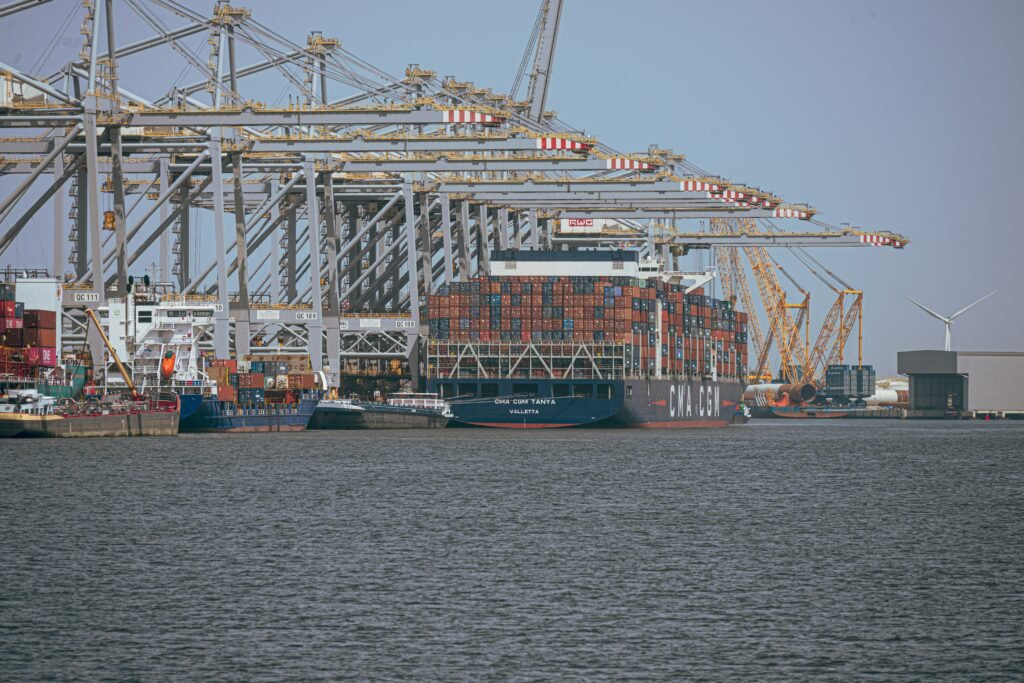
Europe is getting hotter. That statement has become so familiar that it risks becoming economically meaningless. Temperatures rise, records fall, politicians discuss climate change, environmentalists demand faster decarbonisation and sceptics argue about attribution. Meanwhile, something rather more immediate is happening. The physical infrastructure on which the European economy was built is beginning to encounter climatic conditions it was not designed to withstand. The Rhine offers an unusually clear illustration. In August 2026, record-low water levels have forced vessels to reduce their loads, some sailings have stopped altogether and freight has been diverted onto already constrained roads and railways. At Kaub, the notoriously shallow section of the Middle Rhine that acts as a gateway between the North Sea ports and industrial southern Germany, water levels have fallen to the point where shippers have warned that the river could effectively be split in two. Germany has responded by temporarily relaxing restrictions on Sunday truck movements in several states. One barge, however, can require anything approaching 150 trucks to replace it. The Rhine is not merely a picturesque river experiencing an unusually dry summer. It is part of Europe’s industrial machinery.
The Danube tells an even more alarming version of the same story. Record-low water levels have impaired shipping across central and eastern Europe while simultaneously interfering with electricity generation. Hungary’s Paks nuclear plant, normally responsible for almost half the country’s electricity, was recently operating at a fraction of capacity because of conditions on the Danube. Romania has now
shut both reactors at Cernavodă, which normally provide around a fifth of Romanian electricity, because the river can no longer reliably provide the cooling water they require. Moldova, heavily dependent upon Romanian electricity, consequently faces higher prices and greater insecurity. Factories have been asked to reduce consumption. Dacia and Ford have temporarily suspended production. A drought has
travelled from meteorology to hydrology, electricity generation, manufacturing, employment and international energy security without ever needing to cross a national border itself. This is the economic characteristic of extreme heat that governments need to understand. Its consequences are not linear. Forty degrees does not simply mean that everyone becomes somewhat less productive than at thirty degrees. Extreme heat interacts with systems that have thresholds. Rivers become too shallow for fully laden ships. Cooling water becomes too warm or scarce for power stations.
Railway tracks and roads operate outside design tolerances. Reservoirs fall below useful levels. Crops pass biological thresholds beyond which yields deteriorate rapidly. Workers cannot safely perform certain jobs. Electricity demand rises precisely as parts of the generating system become constrained. Wildfires stretch emergency services while destroying homes, forests and tourist revenues. The shocks then begin interacting with one another.
This summer offers plenty of evidence. France has estimated that its recent heatwaves could cost €10 to €15 billion directly and indirectly, while tens of thousands of people have experienced water shortages. Agricultural losses are accumulating across Europe. Wildfires have forced evacuations from Spain and France to Croatia and Greece. The European Environment Agency calculates that weather and climate
extremes cost the EU €822 billion between 1980 and 2024, with average annual losses rising from €8.6 billion during the 1980s to €44.9 billion during 2020–24. Less than one fifth of those historical losses were privately insured.
The temptation is to describe this simply as another cost of climate change. That misses the more interesting economic question. The scale of the damage caused by a heatwave is not determined by temperature alone. It is determined by the interaction between temperature and the resilience of the economy experiencing it.
Two countries can experience the same climatic shock and suffer radically different economic losses. A city built with shade, insulation, ventilation, reflective materials, green spaces and buildings capable of remaining cool without enormous electricity consumption is economically different from one built for a temperate climate and retrofitted with millions of individual air-conditioning units. A railway network
designed to tolerate higher temperatures behaves differently from one whose rails repeatedly require speed restrictions. An industrial company possessing several transport options and weeks of inventory behaves differently from one dependent upon just-in-time deliveries arriving by a single river. A power system containing diverse generation, storage and international interconnectors behaves differently
from one dependent upon several large thermal plants drawing cooling water from the same drought-stricken river.
Climate adaptation is therefore increasingly an issue of productivity, infrastructure and state capacity rather than merely environmental policy. Consider Kaub. The vulnerability is hardly a recent discovery. Plans to improve the navigation channel
through this crucial section of the Rhine date back to 1992. More than three decades later, the work remains unfinished and completion is not expected until around 2033. The engineering itself may take only months; planning, environmental objections, political priorities and administrative procedures have consumed decades. Meanwhile roughly 80% of German inland shipping uses the Rhine and Germany’s industrial heartland remains exposed to a bottleneck whose importance has been
understood for a generation. There is an uncomfortable lesson here. A country can possess world-class engineers, enormous financial resources and sophisticated climate models yet still be vulnerable because its political and administrative systems cannot convert knowledge into infrastructure quickly enough….unlike say China..or Russia.
Climate adaptation exposes the distinction between knowing what needs to be done and possessing the institutional capacity to do it. Deepening every European river is neither feasible nor necessarily desirable. Rivers are ecosystems, not industrial canals, and interventions can create substantial environmental costs elsewhere. More
interestingly, adaptation need not always mean modifying nature to preserve existing technology. Sometimes it means modifying technology to cope with changing nature.
Shipping provides an obvious example. Low-draught barges capable of carrying commercially useful loads at much lower river levels reduce the sensitivity of industrial supply chains to drought. Companies can redesign loading systems, enlarge storage facilities near factories and ports, maintain alternative rail contracts and use digital river forecasts to decide when inventories should be accumulated. The
objective should not be to guarantee that the Rhine always behaves as it did during the twentieth century. It should be to ensure that German industry can continue functioning when it does not. That distinction matters because resilience has a price.
For several decades, European companies were rewarded for removing apparent inefficiencies from supply chains. Warehouses represented tied-up capital. Spare capacity represented an underutilised asset. Multiple suppliers complicated procurement. Inventory sitting unused on a factory site looked inefficient compared with material arriving precisely when production required it. Globalisation and just-in-time manufacturing were extraordinarily successful at reducing those costs. They also assumed a relatively predictable operating environment.
The pandemic exposed one weakness in that assumption. Russia’s invasion of Ukraine exposed another. Repeated droughts and heatwaves are exposing a third. Efficiency measured under normal conditions is not necessarily efficiency measured across an entire economic cycle that includes increasingly frequent disruptions. The economics of resilience therefore resembles the economics of insurance. A spare railway route
looks wasteful until the primary route fails. A warehouse containing several weeks of chemical feedstocks looks inefficient until barges cannot reach Ludwigshafen. Electricity storage looks expensive until several gigawatts of generation disappear during a heatwave. Water reservoirs, redundant interconnectors and emergency generation capacity all appear less productive than assets operating continuously. Their economic value lies precisely in the fact that they are not normally needed.
Governments may consequently have to rethink what constitutes productive investment. The conventional cost-benefit analysis of infrastructure tends to discount capacity that remains idle most of the time. Climate volatility increases the option value of that capacity. There is also a strong case for governments to establish automatic emergency regimes rather than improvising every time temperatures rise. Germany’s relaxation of Sunday trucking restrictions is sensible. It would be more efficient if predetermined river-level thresholds automatically triggered a
package of measures: additional freight paths on railways, temporary regulatory flexibility for road haulage, priority treatment for strategically important cargoes and coordinated use of alternative ports and terminals.
The same principle can apply elsewhere. Heat thresholds could automatically alter construction working hours, allowing more activity early in the morning or evening. Electricity-market rules could trigger demand-response arrangements before generating capacity becomes critically constrained. Agricultural drought indicators could activate water-allocation mechanisms before reservoirs reach emergency
levels. Governments are generally better at responding to predictable crises when the rules governing the response have been designed before the crisis begins.
Forecasting itself consequently becomes infrastructure. If an industrial company discovers on Monday that the Rhine will be unnavigable on Friday, its options
are limited. Every competitor is simultaneously attempting to hire the same trucks, railway wagons and alternative barges. Prices explode because the supply of substitute transport is highly inelastic in the short run. Suppose instead that increasingly sophisticated hydrological forecasting gives the same company a
meaningful probability in April that severe restrictions will occur in July. It can build inventories, schedule maintenance during the vulnerable period, reserve railway capacity and contract alternative transport before scarcity premiums appear.
The drought has not disappeared. Much of its economic cost has.
This illustrates a broader point about information. Climate adaptation is often imagined as concrete, reservoirs and flood defences. Some of the highest-return investment may instead be in meteorology, hydrology, satellite monitoring, agricultural forecasting and data systems capable of translating physical forecasts into decisions businesses can use. Germany is already developing longer-range Rhine forecasting. Governments should treat such information as a public economic good.
The problem becomes more complicated when energy enters the equation. Heat creates an awkward double shock. Electricity demand increases because homes, offices, shops, hospitals and factories require more cooling. At exactly the same time, some electricity generation can become less reliable. Hydroelectric production obviously suffers when water availability falls. Less obviously, nuclear and
conventional thermal power stations can also become constrained because they require large quantities of water for cooling and because environmental rules restrict the temperature at which water can be returned to rivers. The Danube crisis demonstrates that nuclear power is low-carbon but not automatically climate-proof.
This should not become an argument against nuclear power. It is an argument against concentrating energy security around infrastructure sharing the same climatic vulnerability. A resilient European electricity system therefore requires diversity in a different sense from the conventional renewables-versus-nuclear debate. Solar generation has the useful characteristic of producing strongly during many hot periods when air-conditioning demand is high. Wind provides another climatic profile. Nuclear supplies dependable low-carbon baseload when cooling conditions
permit. Storage shifts electricity between periods. Interconnectors allow countries experiencing different weather conditions to support one another. Demand-response systems can temporarily reduce industrial consumption rather than allowing uncontrolled shortages to develop.
The economically important concept is covariance. Ten electricity sources are not genuinely diversified if the same drought disables all ten. Europe’s electricity grid consequently becomes geopolitical infrastructure. A heatwave in Romania can
affect Moldova. Low French nuclear output can alter electricity prices in Germany, Italy or Britain. Reduced hydroelectric production in the Alps or Scandinavia changes regional power flows. Energy interdependence can spread a shock, but it can also absorb one. The difference depends upon whether sufficient transmission and generation capacity exists elsewhere.
The same logic applies to transport. The European Commission describes the Rhine-Danube corridor as the principal west-east transport axis across continental Europe, connecting ports, railways, roads and inland waterways through countries stretching from France and Germany towards the Black Sea and Ukraine. The lower Danube has acquired additional strategic importance as an export route for Ukraine. A drought on the Danube is therefore no longer simply a Romanian, Hungarian or Serbian problem. It can affect Ukrainian grain exports, European food prices, Black Sea logistics and the economic resilience of states sitting close to Russia’s geopolitical frontier.
Climate adaptation and national security are beginning to overlap. Russia’s invasion of Ukraine taught European governments that the cheapest energy system was not
necessarily the most secure one. Climate volatility may teach the same lesson about transport, food and water. A supply chain optimised around one port, one river, one railway or one foreign supplier may be cheaper in normal conditions while carrying a hidden geopolitical and climatic risk premium.
Governments do not need to abandon markets to respond. They do need to ensure that market prices reflect risks that companies might otherwise externalise onto society.
Strategically important industries could be required to maintain business-continuity plans for extreme heat and drought. Critical infrastructure operators could undergo climate stress tests analogous to the financial stress tests imposed on banks. What happens to a chemical complex if Rhine freight capacity falls by 70% for six weeks? What happens to a country’s electricity system if river-cooled nuclear generation and hydroelectric output decline while air-conditioning demand reaches a record? What
happens if the same heatwave simultaneously reduces agricultural production and interrupts grain transport?
The crucial word is simultaneously.
Traditional risk management often examines shocks independently. Climate events compound them. Agriculture illustrates this particularly well. Drought reduces crop yields directly. Irrigation can mitigate the effect, but irrigation increases demand for water precisely when supplies are scarce. Pumping and cooling require electricity precisely when electricity demand is elevated. Livestock require more water.
Rivers carrying grain may become less navigable. Wildfires destroy agricultural land and infrastructure. Food processors face higher input and energy costs. Consumers eventually encounter higher prices. The immediate policy response is often subsidy. Farmers suffer losses and governments compensate them. That may be necessary after exceptional events, but if extreme heat becomes recurrent, permanent compensation risks socialising climate losses while preserving agricultural practices that are no longer economically sustainable.
Adaptation therefore requires harder decisions: different crops, improved soil moisture retention, precision irrigation, recycled water, reservoirs, changes in planting calendars and perhaps the gradual relocation of some agricultural production. Governments will face fierce political resistance because adaptation inevitably creates winners and losers.
That is where climate policy becomes social policy.
A wealthy household can install air conditioning, improve insulation, leave a hot city for several weeks or work remotely. A low-income household living on the top floor of an old apartment building may be unable to do any of those things. An office worker can remain productive at home. A roofer, agricultural worker, delivery driver or construction worker cannot move their occupation onto Zoom.
Heat therefore has distributional consequences even before government policy enters the picture. Research for the European Commission suggests that rising heat stress will reduce labour productivity and GDP across Europe, with southern and south-eastern regions suffering disproportionately. By 2050, productivity losses in the most affected regions could approach 0.9%, with GDP losses around 0.7% relative to a world without the additional heat stress; under severe scenarios without adequate
adaptation the losses become considerably larger. Those percentages sound modest until one remembers that economic growth in mature European economies frequently struggles to exceed one or two per cent a year. A persistent climate-related
productivity loss of even half a percentage point is not a rounding error. It can consume a substantial part of the growth governments require to finance pensions, healthcare, defence and debt service.
The regional distribution may prove politically explosive. Southern Europe is already generally poorer, more indebted and more exposed to extreme heat than northern Europe. If climate change systematically reduces productivity and raises adaptation costs in Spain, Italy, Greece, Portugal and parts of the Balkans faster than in northern Europe, existing economic divergences within the EU could widen. That raises an uncomfortable question for European fiscal politics. Is climate adaptation a national
responsibility or a European one?
A German taxpayer might reasonably ask why they should finance cooling infrastructure in Athens or irrigation systems in Andalusia. A Greek or Spanish taxpayer could reply that the Single Market benefits from preventing entire European regions from becoming less productive and fiscally weaker. Similar arguments already surround cohesion funding, agricultural subsidies and pandemic recovery spending.
Climate adaptation could become the next great argument over European fiscal solidarity.
Insurance will intensify the debate. Historically, less than 20% of European losses from weather and climate extremes have been privately insured, and the proportion for heatwaves, droughts and other climatological events is much lower.
As risks become more predictable, insurers will rationally increase premiums, restrict coverage or withdraw from particularly exposed markets. Governments then face an unpleasant choice. They can allow insurance prices to reveal the true risk, potentially making homes and businesses in some locations difficult to insure or finance. Alternatively, they can subsidise insurance, which protects households in the short term while encouraging people to continue locating assets where losses are
increasingly likely. The problem is familiar from flood insurance but heat and drought expand its scale enormously. Eventually climate adaptation affects property values, mortgage lending and municipal finances. If a region requires expensive cooling, faces recurrent water restrictions, suffers declining agricultural productivity and becomes increasingly expensive to insure, people and capital may gradually move
elsewhere. The tax base then weakens just as local government needs more money for adaptation.
Climate migration need not involve millions of people suddenly fleeing deserts. It can occur quietly through relative property prices, retirement decisions, corporate investment and where young workers choose to live.
Tourism provides another example. For decades southern Europe has benefited enormously from northern Europeans seeking heat and sunshine. There is presumably a temperature beyond which additional heat becomes a disamenity rather than an attraction. If July and August increasingly bring temperatures above 40°C, wildfires, water restrictions and uncomfortable nights, some tourism may migrate towards May, June, September and October, or northwards geographically. That need not destroy Mediterranean tourism. It may redistribute it through the calendar. Hotels,
airlines, schools and labour markets, however, are organised around established seasonal patterns. Adaptation may require Europe gradually to rethink when people work, holiday and even attend school.
This is why the economics of extreme heat cannot be reduced to installing more air conditioners. Air conditioning is simultaneously an adaptation and a source of additional energy demand. If electricity remains carbon-intensive at the margin, cooling can contribute to the emissions producing future warming. Poorly insulated buildings require more cooling than well-designed ones. Urban surfaces absorb heat and increase nighttime temperatures. Waste heat from cooling equipment adds further warmth locally.
The more intelligent strategy begins with buildings and cities: external shading, insulation, ventilation, reflective roofs, trees, green spaces and urban design that reduces heat absorption. Cooling then becomes the final layer rather than the first response.
Water policy presents an even more politically difficult challenge because Europe has spent much of its modern history treating abundant freshwater as almost free.
Scarcity changes the economics. Households want drinking water and cooling. Farmers want irrigation. Industry needs process and cooling water. Electricity generators require rivers and reservoirs. Ecosystems require minimum flows. Tourism increases demand during precisely the hottest months. Governments will increasingly have to decide whose demand takes priority…and ai needs data centres…which need cooling.
Price mechanisms can help. Water that is effectively free provides little incentive to repair leaks, invest in efficient irrigation or recycle industrial supplies. Yet simply increasing water prices can impose severe burdens on poorer households and farmers. A sensible system might guarantee an inexpensive basic household allowance while pricing heavy consumption more aggressively and creating clearer markets or allocation mechanisms for industrial and agricultural users.
Wastewater recycling will become increasingly important. So will storage. Desalination may become economically rational in some coastal areas, particularly where renewable electricity is abundant, although it remains energy-intensive and creates environmental issues of its own. None of these solutions is free. The relevant comparison is no longer with the historically cheap water Europe enjoyed.
It is with the economic cost of not having water when it is needed.
There is a danger that all this becomes an argument for an enormous new category of government spending with little discipline attached. Every road can suddenly become “climate infrastructure”; every subsidy can be described as resilience.
Governments therefore need to distinguish adaptation investments that genuinely reduce expected future losses from projects merely acquiring a fashionable justification.
The appropriate framework is expected value. Suppose strengthening a railway line costs €500 million but reduces the probability and duration of heat-related closures over forty years. Suppose investing €1 billion in Rhine logistics prevents several billion euros of expected industrial disruption. Suppose urban cooling measures reduce hospital admissions, mortality, electricity consumption and lost working days
simultaneously. These benefits should be valued together rather than assigned to separate departmental budgets. That requires governments to become better at thinking across systems. Transport ministries optimise transport. Energy ministries optimise electricity. Agriculture ministries protect farmers. Health ministries prepare hospitals. Environment ministries manage water.
Climate shocks ignore those administrative boundaries.
The European Environment Agency warns specifically about cascading and compounding climate risks. The phrase sounds bureaucratic, but it describes precisely what Europe is experiencing. A hot summer becomes a drought. The drought becomes a shipping problem. The shipping problem becomes an industrial problem. Low water becomes an electricity problem. Expensive electricity becomes another industrial problem. Crop failures become a food-price problem. Wildfires become a tourism and
insurance problem. Lost working hours become a productivity problem. Governments then encounter weaker tax receipts alongside higher emergency expenditure.
Eventually a weather event becomes a macroeconomic event.
That matters for monetary policy as well. Climate shocks can simultaneously reduce supply and increase prices. Food becomes more expensive, electricity prices rise, freight rates increase and industrial production falls. Central banks then confront the unpleasant combination of weaker growth and inflationary pressure.
Raising interest rates cannot make the Rhine deeper or cause wheat to grow in a drought. Yet if repeated climate shocks push inflation expectations higher, central banks cannot simply ignore them either.
Climate resilience therefore has a monetary-policy dividend. An economy capable of absorbing physical shocks with smaller interruptions to supply is less likely to experience repeated bouts of climate-induced inflation. Investment in reservoirs, grids, railways, storage and logistics can consequently be viewed not merely as environmental spending but as investment in macroeconomic stability. There is a similar fiscal argument. Governments can pay before a crisis or after it. Beforehand the money is called investment and often attracts political criticism. Afterwards it becomes emergency support, reconstruction, agricultural compensation, energy subsidies and disaster relief and is politically unavoidable.
Prevention has an awkward electoral characteristic: successful adaptation produces events that do not happen.
No politician cuts a ribbon in front of the factory that did not close because adequate railway capacity existed. Newspapers do not photograph the electricity blackout prevented by grid storage. Voters rarely notice the hospital admissions avoided because their neighbourhood was redesigned to reduce heat. The political rewards from adaptation are therefore delayed and largely invisible, while the costs are
immediate and measurable. That creates a systematic bias towards underinvestment.
There is an additional intergenerational problem. A government spending billions today may create infrastructure whose largest benefits arrive twenty years later under another administration. The political discount rate is considerably higher than the social one.
Europe’s ageing population complicates matters further. Governments already face enormous demands for pensions, healthcare and defence while public debt remains high in several major economies. Climate adaptation will compete for scarce fiscal resources rather than arriving in an empty budget. The obvious response is to prioritise investments with multiple benefits. Better electricity grids assist
decarbonisation, energy security and heat resilience simultaneously. Improved rail freight reduces emissions while providing an alternative to vulnerable waterways. Building renovation lowers winter heating bills as well as summer cooling demand. Water-efficiency programmes reduce drought exposure and operating costs. Urban trees and green spaces reduce heat while improving air quality
and quality of life.
The artificial distinction between climate mitigation and climate adaptation consequently becomes less useful.
Mitigation attempts to reduce the climatic change ultimately experienced. Adaptation reduces the damage caused by the change that nevertheless occurs. Europe needs both.There is, however, a legitimate question about the allocation of marginal resources between them. For thirty years climate economics has understandably concentrated on mitigation: carbon prices, renewable energy, electric vehicles, emissions targets and the enormous challenge of reaching net zero. Yet even exceptionally successful European decarbonisation cannot determine Europe’s climate independently. The EU produces only a fraction of global emissions. Europe’s future temperatures will depend substantially on decisions made in China, India, the United States and elsewhere. Europe can influence those decisions diplomatically and technologically. It cannot control them.
It can control whether its railway tracks tolerate 40°C, whether its electricity grid has sufficient interconnection, whether buildings remain habitable during heatwaves, whether industries have alternative transport routes and whether governments possess functioning drought plans. That creates a powerful argument for increasing the relative importance of adaptation within climate policy. Not instead of reducing emissions, but alongside it. The European Commission estimates that, across climate scenarios, annual EU losses could eventually reach 2.2% of GDP by 2070, while a quarter of European regions could experience losses exceeding 5%. If warming remains persistently above the Paris Agreement’s 1.5°C threshold, cumulative additional EU GDP losses between 2031 and 2050 have been estimated at €2.4 trillion.
Numbers that large change the meaning of adaptation spending.
A €10 billion resilience programme sounds expensive considered as expenditure. It can look remarkably cheap considered as an insurance premium against trillions in cumulative losses.
There will nevertheless be limits to adaptation. We cannot simply engineer our way out of indefinitely rising temperatures. Some ecosystems cannot be protected by air conditioning. Agriculture cannot always be maintained through irrigation if the water itself disappears. Some coastal areas cannot economically be defended forever. Human physiology places limits on safe outdoor labour. Adaptation becomes increasingly expensive as climatic change intensifies. That is precisely why mitigation remains necessary. Yet the reverse is equally true. Even if global emissions began falling dramatically tomorrow, Europe would still experience substantial climatic change because of warming already embedded in the system. Mitigation without adaptation therefore amounts to protecting the climate of the second half of
the century while leaving citizens inadequately protected from the climate arriving next summer.
The Rhine makes the argument visible because it transforms something abstract into something almost absurdly concrete.
Europe possesses one of the world’s most advanced economies. Germany possesses extraordinary industrial capabilities. Yet chemicals, steel, fuel and agricultural commodities can still be stranded because there is not enough water beneath a barge.
The immediate reaction is to ask when it will rain.
The more important question is why rain should have so much power over European GDP in the first place.
Rivers will continue to rise and fall. Heatwaves will come and go. Individual summers will always contain natural variability, and not every drought should be mechanically attributed to climate change. The policy question does not require certainty about any individual event. Governments routinely insure against risks whose precise timing cannot be predicted.If extreme heat and drought are becoming more probable, then the expected return from resilience investment rises accordingly. That should change how governments calculate infrastructure spending, how companies design supply
chains, how banks assess loans, how insurers price property, how farmers use water, how cities are built and how Europe thinks about economic security.
The greatest conceptual change may be abandoning the assumption that resilience is the opposite of efficiency.
For much of the globalisation era, efficiency meant eliminating redundancy. In a more volatile physical and geopolitical environment, redundancy can itself be efficient because it reduces the expected cost of failure. A second railway connection, an additional reservoir, spare electricity generation, another supplier or
three weeks of inventory may look wasteful on a spreadsheet constructed around an average year. The spreadsheet changes when the distribution of possible years changes.
Economics has always been about scarcity. Climate change is altering what is scarce.
At different moments Europe may find itself short of water, electricity, navigable rivers, agricultural output, cool working hours, firefighting capacity or insurance capital. Prices will adjust to some of these shortages. Markets will encourage adaptation. Companies will innovate and individuals will move.
Governments nevertheless determine much of the infrastructure through which those adjustments must occur. Rivers, grids, railways, roads, planning systems and water rights are not ordinary consumer markets. Their investment horizons extend across generations and their failures create enormous externalities.
The appropriate response to Europe’s 40°C summers is therefore neither panic nor fatalism.
It is investment.
Build electricity systems whose components do not share the same vulnerabilities. Build transport networks capable of switching between river, rail and road. Build vessels for the rivers Europe is likely to have rather than the rivers it remembers. Store more strategically important materials. Forecast drought earlier. Price water intelligently. Recycle more of it. Change building codes. Shade cities. Adjust
working practices. Stress-test critical industries. Make emergency regulations automatic rather than improvised. Accelerate infrastructure planning where thirty-year approval processes have themselves become an economic risk.
Above all, governments should begin treating extreme heat as an economic-security issue.
Europe spent much of the past decade discovering the danger of depending upon geopolitical stability for its energy.
It should not spend the next decade discovering that it also depended upon climatic
stability for its prosperity.
The smoke on the water this summer is not simply a warning about the temperature.
It is a warning that an economy designed around yesterday’s climate may become increasingly expensive to operate in tomorrow’s.
The choice is not between stopping climate change and adapting to it. Europe has to attempt both.
The more interesting question is whether it can adapt quickly enough.
Because 40°C is no longer merely a weather forecast. It is becoming an economic variable.